"To compensate a little for the treachery and weakness of my memory, so extreme that it has happened to me more than once to pick up again, as recent and unknown to me, books which I had read carefully a few years before . . . I have adopted the habit for some time now of adding at the end of each book . . . the time I finished reading it and the judgment I have derived of it as a whole, so that this may represent to me at least the sense and general idea I had conceived of the author in reading it." (Montaigne, Book II, Essay 10 (publ. 1580))

Showing posts with label Greene. Show all posts

Friday, November 29, 2013

The Honorary Consul (Graham Greene, 1973)

I like Greene's books, and will continue to work through them.

Protagonist is a doctor (Plarr) who moved south from Paraguay with his mother when a child - leaving behind his politically dubious father (in a country where that always seems to be a big problem).  Now he lives in a small town near the Paraguayan border.  Half-English and half Paraguayan; identifies with the local English community (consisting of three members, including him).  The Honorary Consul (English) is an aging mediocrity with a new, young wife who Plarr finds interesting, let's say.

The Honorary Consul is mistakenly kidnapped and held for ransom with some desperate amateurs who were going after the U.S. ambassador.  The kidnappers are Paraguayans with information about Plarr's father; Plarr is mixed up in their activities.  Head of the kidnapper group is a former priest, which gives Greene some room to work in his Catholic themes.

Good, I liked it.

Thursday, November 15, 2012

The Heart of the Matter (Graham Greene, 1948)

I liked this a lot in the beginning stages of the book, then felt it broke down toward the end - partly because I didn't think the reliance on Catholic doctrine of the period to create tension in the lead character (Scobie) was particularly effective.

Now I learn that Time magazine has this book in the top 100 English-language novels since 1923; the Modern Library ranked it 40th.  That surprises me.

Short, and definitely a good read - always held my attention.  I like Greene's writing - he sees us.

Scobie is an inspector in a West African country during WWII; his wife is unhappy; he pities her; borrows money from a Syrian smuggler to pay her passage out of the colony; inspects a suicide at an inland station; inspects a Portuguese ship and uncharacteristically doesn't bust its captain for a Germany-bound letter; Wilson keeps an eye on him (and on his wife); Scobie meets a survivor of a shipwreck and falls in love; further adventures follow.  Wilson shares lodgings with a veteran of the colony who amused himself by going after cockroaches.

I have no idea what life is like in one of these colonies but trust that Greene (who worked in one) did a great job describing it.

Monday, December 20, 2010

The End of the Affair (Graham Greene, 1951)

This was quite different from Our Man in Havana and The Quiet American. Set mostly in WWII London; protagonist has an affair with wife of an acquaintance; various characters deal with the question of belief in God in a Catholic sort of way; this takes an unexpected turn in the latter part of the book. The private detective's son recovers; the rationalist's facial markings disappear.

I liked. Perhaps should try the movie version(s) (1955, 1999).

Wednesday, March 25, 2009

Our Man in Havana (Graham Greene, 1958)

A light read but entertaining. I didn't realize this had been made into a movie with Alec Guinness.

Greene pokes fun at the intelligence community, much of which "fun" was quite on point as far as I know - inter-agency rivalries as well as rivalries among ostensible allies. Somehow that allowed a vacuum cleaner salesman to become a highly-touted intelligence source in 1950s Havana - despite the low quality (to be kind) of the intelligence being supplied. I liked it.

Monday, January 15, 2007

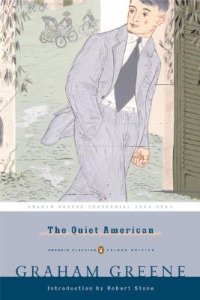
The Quiet American (Graham Greene, 1955)

An English reporter living in Viet Nam during time of fighting between French and Vietnamese (Communist) is the narrator. Mid-1950s. The narrator had pretty much "gone native," living with a local woman, regularly taking opium, etc. An American arrives as an economic attache; actually doing undercover work for a "third force" - an unreliable local warlord - in an effort to stave off the Communists. American steals girl from narrator (to his great disappointment) and saves the narrator's life when they are stranded in open country. Narrator recognizes unreliability of naive American, could be said to have a hand in the American's assassination. But he does get his woman back.

I liked this a lot. Never read anything by Graham Greene before and don't know a thing about him. The introduction to this edition of the book said he grew up in the public school tradition of service and would have believed in Britain's historic international role. I'll read more. His bio is here. The book gave one man's take on the situation in Vietnam.

I was listening to a song by Nanci Griffith, who I like a lot, at the gym this evening. She is active in Vietnam veterans' matters. (In fact, during her appearance at the Alaska Folk Festival in 2006, it was reported by one Carol Gales that she yakked about that type of thing too much and didn't sing enough.) Anyway, she mentions the name of this book and the author a couple times in one of her songs about Indochina.