"To compensate a little for the treachery and weakness of my memory, so extreme that it has happened to me more than once to pick up again, as recent and unknown to me, books which I had read carefully a few years before . . . I have adopted the habit for some time now of adding at the end of each book . . . the time I finished reading it and the judgment I have derived of it as a whole, so that this may represent to me at least the sense and general idea I had conceived of the author in reading it." (Montaigne, Book II, Essay 10 (publ. 1580))

Showing posts with label classical. Show all posts

Tuesday, April 07, 2026

Persian Fire - The First World Empire and the Battle for the West (Tom Holland, 2005)

Much of this covers pretty familiar ground - but lots of interesting new details and Holland always has an interesting take on things. I had read an innovative way of telling the story last year, so this book was an excellent follow-on. 

Assyrian to Medes to Persians. Via Cyrus. All three groups crazy successful, especially the Persians.

Darius usurps from Cyrus #2 son who usurped from Cyrus #1 son (Cambyses) 

Persians as relative upstarts coming in from the east.

Sparta - what a culture.

Athens democracy arrives in 507 BC as a last resort for Cleisthenes   This happens during the reign of Darius.  Implementing democracy - or something - seemed to galvanize the population. 

Battle of Marathon page 195 and following. A completely unexpected victory for Athens acting pretty much by itself.

Notwithstanding land battle success, Themistocles persuades Athens to build ships and rely on a navy for the next fight. This was a difficult persuasive effort.

Xerxes succeeds Darius and prepares to teach Athens and Sparta a lesson, great preparation underway.

Page 258 explaining the 300 - Spartans remove main army because of religious holiday normally requiring truce. The 300, plus some allies, were thought or hoped to be sufficient to hold Thermopylae.  It worked out well enough. 

The battle concludes after Thermopylae with some naval engagements etc.  Persia makes a few more attempts, but Xerxes needs to head home and invasion efforts finally fizzle out.

Wednesday, July 16, 2025

Papyrus - The Invention of Books in the Ancient World (Irene Vallejo, 2022)

(384 pages) (gift from Paul Jr & Nedda)

So many interesting things going on; hard to summarize the book though the title actually does a pretty good job. I take books for granted. This explains lots about the path from oral tradition to writings to writings-in-book-form, and about how some of the oldest texts somehow survived.  The author does this in a consistently interesting way.

Lots of focus on ancient Greece - where it all started - lots on the Library of Alexandria and the Ptolemies (Alexander the Great local successors) spending lots of money sending emissaries in an effort to collect every book in existence.

Some thoughts - 

--How the ancient epics survived and evolved relying on memory and storytellers.  Once written down, the tale settles into fixed format - probably a good thing but still. 

--Why it makes sense that poetry and singing dominated when memory was the primary or only method of preservation - think of how we can remember poems and songs compared to prose. (From grade school, one of the few verbatim items I recall is six lines memorized from Whittier's Snowbound (a punishment for talking in class, some of the students learned quite a few lines).

-Papyrus as a legitimate marvel - but clumsy to work with, and the shelf life isn't that long.  Many re-writes needed for an old text to make it to Gutenberg, many opportunities for loss or error.

--Just the amazing-ness as humans transition from memory-reliance to a system that can preserve all knowledge for all time (with gaps that decrease over time).  

--Setting up library systems - goes back to Alexandria and beyond.  References to The Name of the Rose, of course. Handling, storing, preserving scrolls; arranging re-writes (which to choose?)

--A good discussion of the challenges of translation - an unavoidable necessity but one that necessarily creates something of a new work.

--Interesting discussion of Rome - so backward compared to Greece; Greek slaves could read and often ended up as tutors in wealthy Roman homes. Rome owned it - always acknowledge Greek primacy (though potshots about this being effeminate, of course).

--Development of the codex format - higher efficiency than scrolls.

--Censorship over the millennia.  Horace was banished.  Etc.

--The incredible fall-off after Rome lost its mojo.  A risky period, much was lost but the monasteries and the Islamic world eventually saved a lot (not in the scope of this book)  

Sunday, January 16, 2011

B Minor Mass (Johann Sebastian Bach, in segments between 1724 and 1748)

PJ and I had the good fortune to attend a performance of Bach's "Mass in B minor" on Saturday evening (1/15/11) - part of the Arizona Bach Festival. Performance was at Central United Methodist Church. We arrived reasonably on time by our standards, but the place was packed. Our luck (and PJ's find): they were putting up some additional chairs in the transepts, and we ended up in the front row. So had a great side view, could see the conductor throughout - somewhat like the view we have when performing with Choral Union.

After listening to it so often on CD, it was quite an experience to hear a fine live performance. Unoriginal observations: the CD doesn't pick up all the depth of the sound, and certainly doesn't pick up the echoes and reverberations in a church setting.

Quoted at the bottom of the post is a summary from NPR which I like (relating to a CD it's selling). I'm posting the album cover of the version we have on CD, which really is quite fine.

The Phoenix Chorale sounded wonderful - which was good news, since this is primarily a choral work. The festival orchestra also sounded very nice. We weren't completely sold on the soloists, but there were many nice moments.

For me: I still like the Kyrie section best. The first part is almost hypnotic; then a change of pace with two soloists doing the "Christe eleison"; then I much like the final Kyrie eleison as it leads into the Gloria. But the entire thing is a delight, even if two hours is a bit long to be sitting.

After: late dinner at the Vig with my pal.

NPR's take:

"April 7, 2009 - The Mass in B minor is as lofty in design, scope and expression as anything written by the hand of man. It's one of several instances in the music of Johann Sebastian Bach in which a piece is created as an ideal type, rather than crafted for a practical use. As such, it represents an attempt to both summarize the tradition of the mass in a single perfect specimen and leave a statement on the nature of sacred music as a bequest to the future.

Most of the work's component parts date from various times in Bach's long residence in Leipzig; they were assembled to form a complete mass only near the end of his life. The earliest section is the Sanctus, from 1724. The Kyrie and Gloria are taken from a 1733 mass that Bach dedicated to the electoral court of Saxony at Dresden. The last major addition was the Credo; the keystone to the whole archlike structure, and itself a wonderfully symmetrical arch, it was written in 1748-49. Bach never heard the work in its entirety, but it represents a collection of movements in diverse styles; the Mass in B minor transcends the inconsistency of its origins."

Sunday, February 10, 2008

Danwen Jian (Violin) Walter Cosand (Piano) (Katzen Hall, February 10, 2008)

It was a beautiful Sunday here in Phoenix, sunny and upper 70s. Patricia and I hiked in the Phoenix mountain preserve (40th street trailhead), then went to this faculty recital down at ASU.

We enjoyed it a bunch. There were four works on the program - a sonata by Schubert, two 20th century American works (Lukas Foss and Russell Bennett), and a sonata (No. 3 in D minor, Op. 108) by Brahms. The opening piece (Schubert) was the least interesting (or maybe our performers (or we audience members) were just getting warmed up). The 20th century pieces were delightful; I always have low expectations for these things and should know better by now. There were parts that were very pretty; some elements of swing or jazz; etc. And we always like Brahms it seems; his piece asked a lot of the pianist (not surprisingly).

I like watching the violinist play. It's interesting to see all the ways they can make sound come out of the violin.

Then to Roaring Fork where they feature a ridiculously cheap and good happy hour menu, plus the bartender comp'd a round. Get the green chile pork stew. What a deal.

Tuesday, September 11, 2007

Robert Spring and a Whole Lot of Friends (Katzin Concert Hall, September 9, 2007)


The ASU faculty and student recital season ends in late April, so we were glad to see things starting up again. We went to a concert featuring a clarinet player. The guy (Robert Spring) has an effective personality and is quite the showman. The first half of the program involved some brand new compositions, including one piece (Chamber Concerto #2) where the composer was present for its premiere. It involved violin, viola, cello, percussion. I was ok with it, PJ not so much.

The second part of the concert involved the clarinet guy and piano accompaniments.

Very much worth the trip down, it's very nice to have access to live music like this.

Monday, January 29, 2007

Chopin piano recital

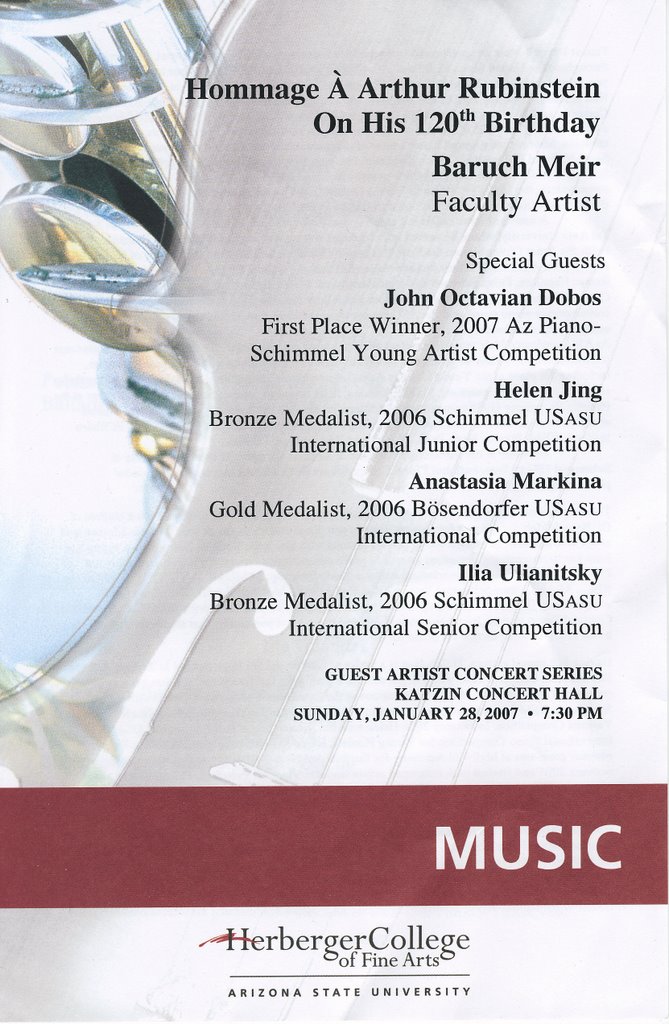
Patricia and I went to an all-Chopin performance at Katzen Hall (ASU campus) on Sunday night. (This was after a nice early dinner at the Z Tejas in Tempe - the chicken quesadilla and chile verde were fine indeed.) The premise was the 120th birthday of Arthur Rubenstein, who recorded mucho piano works by his Polish compatriot. Short lecture followed by a film of Rubenstein (which could have been shortened a bunch or skipped altogether). The playing was most enjoyable; we liked the faculty performer plus Ilia Ulianitsky and Helen Jing.

An extremely pleasant evening. Small crowd, which is hard to figure. Info on Rubenstein is here.

Sunday, January 14, 2007

Piano competition


For the second year in a row, Patricia and I attended the Schimmel Bosendorfer USASU piano competition (now that's a mouthful) at Katzen Hall at Arizona State University. This year, we suckered Paul Jr. into accompanying us. The concept is great for the audience -- it combines interesting, nicely-performed piano music with a competition setting. There are three divisions. The "junior" group is fun - kids 16 and under - absolutely amazing what they can do. I include the program notes for Min Soo Hong, who was the most entertaining perfomer of the entire evening. A 13-year-old kid who really went for it. The "senior" group is up a distinct level in quality. I also include the program notes for a young lady from this group who performed well, but she was especially noticeable because of her, let's say, unusual facial expressions and overall contortions.

The adjudication sessions are open to the public but we didn't make it this year. Patricia went last year and I hope we can get to one next year.

(Note the photo of the happy attendees taken with the camera in my new phone - a new era for me in photojournalism.)

This is a nice event which likely will recur annually. I hope it does.