"To compensate a little for the treachery and weakness of my memory, so extreme that it has happened to me more than once to pick up again, as recent and unknown to me, books which I had read carefully a few years before . . . I have adopted the habit for some time now of adding at the end of each book . . . the time I finished reading it and the judgment I have derived of it as a whole, so that this may represent to me at least the sense and general idea I had conceived of the author in reading it." (Montaigne, Book II, Essay 10 (publ. 1580))

Showing posts with label Germany. Show all posts

Thursday, February 05, 2026

The World of Yesterday (Stefan Zweig, early 1940s)

(389 pages) (passed along by Paul Jr)

Finish wasn't expected. Ended his days in South America in February 1942 (with his wife) - difficult to find a landing spot (as so many Jews experienced), cumulative burden of many difficult years and experiences during the world wars and interwar period, more factors than I can grasp.

The loss of his passport in the 1930s hit Zweig hard - like the Wandering Jews - a deep (and correct) feeling of no place to call home. Hard to imagine.

I didn't know much about him, just had very much enjoyed his novel Beware of Pity. He authored all sorts of interesting things - plays, articles - not so many novels (which I'm normally on the hunt for). Collaborated with big names for his plays. 

In the large group of Jews fully assimilated into Viennese society in early 20th century. Successes early as a writer got his name out there and he met an incredible number of famous names.  There was a lot going on in Vienna prior to World War I! He spent a lot of time abroad and particularly loved hanging out in Paris.

His works were completely banned in Germany by the Nazis. Including a libretto written for erstwhile Nazi favorite Richard Strauss.

His discussion echoed other books I've read about the momentous eras he lived through, just on a more personal level.  The golden years leading up to WWI (and disbelief that it happened). The WWI years.  The interwar years; the rise of Hitler; the seeming inevitability of WWII; incredible and increasing difficulties for Jews. That's a lot to live through. 

He was exposed to, and hung out with, an incredible concentration of high-end talent across many disciplines. Fascinating.


Tuesday, November 25, 2025

The Siege of Berlin and other stories (Alphonse Daudet, 1873)

Poking through the "Harvard Classics," I gave a try to this set of five or six stories. Rather patriotic in tone by this French author; stories are set in the Franco-Prussian was of 1870 (a disaster for France). Characters without much depth. Super easy read but not particularly recommended. 

Tuesday, November 19, 2024

The Savage Storm - The Battle for Italy 1943 (James Holland, 2023)

(476 pages)

I've been lucky to run across quite a few WWII histories that are very high quality - but this one is a definite favorite - the author was completely effective in knitting an overview of the military strategy and key battles with many contemporary excerpts from diaries, letters and the like; these latter gathered from grunts and officers in American, British, German, and Italian armies; also Italian citizens, Ernie Pyle, etc.  

I'll let the author explain - 

"I have been studying the long and terrible Second World War for some years now, but nothing has moved me in quite such a profound way as researching and writing this book.  Perhaps it's because, for the first time, I've used mostly contemporary sources:  diaries, letters, signals and memoranda, and photographs taken in a split second.  Rather than hearing the memories of those times fifty, sixty or even seventy years on, my cast of very real characters have drawn from the testimonies they recorded at the time. I have deliberately tried to avoid any forward projection and to write purely in the moments, hours and days in which the events described were taking place.  None of those writing diaries and letters knew when Rome would fall. None of them knew when the war would end.  I have found it difficult not to be swept up in their experiences, their suffering, their anxieties, their fears and it has been impossible not to care about their fates." (p. 474)

I was definitely swept up.  It also helped that Irvin Bormann and Vernon Hohenberger were literally there for big chunks of the 1943 timeline covered in this book - Irvin's diaries and Hohenberger's memoir include items that are 100% on point with descriptions here; makes it much more personal.

Some things I have a better grasp of -

--The Allies attacked Sicily earlier in 1943 with overwhelming force and encountered weak Italian resistance in many cases.  Plenty of landing craft available to bring all the stuff that a mechanized army needs, especially when the strategy is to overwhelm the enemy with aircraft and artillery to reduce the expenditure of soldiers' lives.

--Italy in this second half of 1943 was not like this.  Resources were diverted to preparations for Normandy and for the war in the Pacific.  Sicilian success perhaps gave too much confidence; the politicians and high command were promising "Rome by Christmas" and no one could back off this push even though it pretty quickly became evident that there soon was no basis for achieving this goal.

--Landing craft in particular were key - I didn't think about how new large-scale amphibious assault was (not a thing in WWI) - these craft just didn't exist in sufficient numbers to bring all the stuff needed. As manufacturing ramps up, many diverted to Pacific and Normandy.

--And to some extent the lack of mechanized support and artillery didn't matter - horrific winter weather and isolated mountainous terrain made aircraft and tanks and shelling less effective. 

--Italy surrendered in September 1943, and the German army took over - much tougher resistance than encountered in Sicily.  Hitler very concerned about this southern approach to Germany.

--The mountains were just made for defense; and the Germans were expert at exploiting this. Whereas an attacking force might be assumed to need a 3:1 numbers advantage, it probably was higher here. Divisions were pulled out of the line (Normandy), soldiers were expected to keep going way beyond normal tours.

--Yet the decision was made to keep going.  Which meant the infantry had such a terrible time of it here.  

--Mark Clark takes a lot of grief, but this author pins the blame higher up the chain, thinks Clark did well under the circumstances.

--I hadn't read much about the Salerno landing - difficult, interesting.

--The civilian suffering - the mechanized, heavy shelling approach had very different consequences in populated Italy as compared to the North African deserts. The sad stories here, wow.

This book wraps up at year-end, so author doesn't get to Anzio, Rapido River crossing; Irvin Bormann DOW on February 1, 1944 so we don't get battles in his final month. Irvin does mention seeing a big battle down in a valley in the December 15-17, 1943 time frame; that could well have been for San Pietro (p. 440).

Thursday, October 10, 2024

Sicily '43 - The First Assault on Fortress Europe (James Holland, 2020)

(499 pages)

I'd never read much about this - it sort of falls into a gap between all the activity in North Africa and then larger Italian mainland campaign.

Summer 1943; largest amphibious landing to that point, by a long shot.  So there was lots of learning to be done.

Success seems inevitable in hindsight.  But terribly difficult. Very difficult to storm beaches even with materiel advantages.

Nighttime paratrooper drops - disaster.  Little effect on outcome, however.  Lots to learn, somewhat helpful at Normandy.

Italian troops just not ready - or inspired- in any sense - offered little resistance.

Hermann Goering division touted by name but cobbled together and not very effective.

German balancing needs on eastern front - Kursk battle going on right at this time (July 1943).  Hitler worried about "southern flank" and does move men and material from the east.

German reinforcements arrive - higher quality. Many very difficult local situations, lots of casualties, seems discouraging in a fight whose outcome both sides could readily foresee.  Germans fall back to the NE corner of the island, then they do a good job falling back into the "toe" of the Italian "boot".  And surviving to make difficult fighting for the Allies as they push up into Italy (the author's next book).

This author does a good job weaving individual narratives within the overall story line.  Also history of Sicily, including mafioso development (the Fascists had mostly subdued them and many emigrated to America; the Allies found them useful including in the postwar period, reinvigorating them).  I hadn't known much about Sicily before this other than classical tales, Arab pirates, lingering poverty.

Thursday, January 11, 2024

Goethe - Life as a Work of Art (Rudiger Safranski, 2013)

I spent a lot of time on this biography.  Not quite sure what I think of Goethe, or what I learn from this.

I read a Goethe biography in 2006 that did a very good job of outlining his life; this biography is discussed here.  

The author of the current biography had greater access to diaries and letters of Goethe and folks with whom he was in contact.  That was interesting.

Part of the interest is Goethe as a leading figure starting in the 1770s - royalty doing quite well, even the minor royalty in the German principalities. Along comes the French Revolution (with agitation for democracy and nationalism in France), the Napoleonic era (with this agitation spreading along with the French armies and encompassing the substates in Germany), Napoleon's defeat and the conservative if not reactionary governments throughout Europe, with Metternich as a key figure.  Then the revolution in France again in 1830.  Goethe lived through all of this and was personally acquainted with all these leaders.

He started out with an early "Romantic era" book (The Sorrows of Young Werther) that took the literary world by storm - somehow striking just the right chord at just the right moment. (It's what Napoleon wanted to talk about in their meeting decades later.) This success - of course supplemented by later actions - facilitated "famousness" throughout his long life.  His life took a major turn when the grand duke in charge of Weimar persuaded him to settle there - a smallish state, it was a coup to land Goethe; the grand duke put Goethe in charge of all sorts of things even though Goethe had little expertise. It made him a much more practical person, if not a conservative as the decades rolled along.  Very impressed by Napoleon and wore the French Legion of Honor (awarded to him by Napoleon) all too often for the tastes of many Germans.

Went through a genuine scare when French troops occupied Weimar, including his residence.  Contributed to his dislike of disorder, nationalism, public passions, etc.

Seems like he was an incredibly gifted person in terms of social skills, and could apply this to both men and women. Descriptions of his romantic relationships; seems like he took advantage of his skills in some situations where he should have refrained. 

The 2006 biography talks about the famous people he interacted with.

Uncanny ability to compose poetry and write all sorts of kinds of literature. Difficulty finishing longer works.

Migrating away from Sturm und Drang - he took a great interest in minerology, sparked by his position as official in charge of Weimar mines.  Another favorite topic - how humans perceive color.  As the years by he kept writing but felt that pursuits in the natural sciences were more worthy.

By the time he passed away in the early 1830s - time had passed him by.  Not popular with young Germans.  Seems like his reputation has recovered, though I don't know how much his works are read.

Not sure what to make of him. 

Friday, August 18, 2023

The Last Hill - The Epic Story of a Ranger Battalion and the Battle that Defined WWII (Bob Drury and Tom Clavin, 2022)

(364 pages)

I liked this.  Kind of a pop history style (as can be told from the overwrought title), but no question that the authors did plenty of research to support the story line.  I also like that it focuses on a small group.

Brits had some success with "commando" (special forces) units early in WWII, and the US decided to do a similar concept though with a different name ("Rangers").  Though the Army didn't have a clear concept of how to use the units, and there were plenty of folks within the Army that didn't like the idea.

The book focuses on the 2nd Ranger Battalion - through intense training (lots of washouts); then onto Omaha beach and up the cliffs to Pont d'Huc; attacking Brest (Brittany - achieving a rather incredible surrender with two Rangers and a grenade in the commandant's crotch); then (after some less intense assignments) into the Hurtgen Forest and Hill 400.

All of these deployments were highly interesting to read about; impressive.  I hadn't known about the Brest surrender before (I assume the description is accurate if unbelievable).  Also hadn't read about Hurtgen Forest - the authors suggest this was not much discussed because (at least in their opinion) so many US lives were wasted repeating attack methods that were proven failures.

Monday, August 22, 2022

Vertigo (W.G. Sebald, 1990)

(263 pages)

This is an odd book.  Saw a review that sounded interesting; enjoyed reading it; but I don't know what to make of it.  

Starts with an episode from the Napoleonic wars - the invasion into northern Italy in 1800.  One of the French soldiers has experiences there. These are reflected back on, amplified, re-examined over the years.

Makes me think of Proust - role of memory, how memory works; in-depth local history; comparisons to art works. 

Makes me think of Kafka - the foregoing with the surreal elements.

A character returns to an isolated small town home after decades away living in cities - some of this resonated with me.  The local details, the knowledge of everyone living there.

Overlapping looks at Marengo, visits between Austria and various sites in northern Italy, etc - made me think of the approach used by the authors of very-recently read books: The Alexandria Quartet, Trust.

Thursday, December 10, 2020

Arch of Triumph (Erich Maria Remarque, 1945)

(535 pages)

Protagonist (Ravic) is a skilled German surgeon who lost citizenship in Nazi times; he's illegally performing surgeries for two well-known (but not as talented) Paris surgeons.  Can't get citizenship elsewhere.  Action occurs between the wars.  He meets various other stateless folks; it's an interesting/effective take on the way they lived.  Occasional deportations.  He lives in a hotel that caters to folks like this.  Encounters an actress.  I always enjoy Remarque's stuff, though didn't like this as much as All Quiet on the Western Front or Three Comrades.  

Monday, April 27, 2020

Three Comrades (Erich Maria Remarque, 1936)

(480 pages)

Book club selection (via Chris; session held (via Zoom) 24 April 2020).

Hadn't read this since 2011 (description here); I liked it even better this time around.

a favorite love story; cf'd to PJ - author got it right - the uncertainty in the early going, the mystery, the girl-part, the "that's sufficient" part
_______________

a favorite buddy story - the scene where Otto hands the pill to Robbie; the scene where Robbie thinks to contact Koster when needing help at the seashore; fundraising in what had to be a painful way
________________

WWI endlessly interesting in part because the soldiers had such a mind-blowing experience.  of course it's hard to compare from war to war - but the jump in firepower and technology (gas, planes, etc.) relative to what soldiers were familiar with, and how tactics were used - not sure what would be like this.  and they hadn't seen newsreels or really anything that would prepare visually.

survivors then come back to Weimar situation . . . after all the sacrifice and suffering (including home front folks like Pat) - no jobs, no hope

demagogues arise per usual
_________________

the spare writing style works for me - similar to All Quiet OTWF

Magic Mountain - sanitarium scenes

Sunday, October 06, 2019

The Adventures of Simplicius Simplicissimus (Hans J.C. von Grimmelshausen, 1650s or 1660s?)

(462 pages)

Author was a soldier in the Thirty Years War - so this book is quite unique in providing an authentic voice.

The first part of the book famously describes some of the horrors of that conflict, but it turns out that most of the book goes elsewhere - the protagonist is a bit of a roustabout.  Relevant to the war - participants switching sides; way too much wanton cruelty; the difficulty of separating war from brigandage.

Entertaining, but not as interesting as expected.

Wednesday, September 18, 2019

Stalingrad (Vasily Grossman, 1952 (English translation 2019)

(961 pages)

Companion work with Grossman's Life and Fate (wonderful in its own right).

This book was written much more circumspectly than Life and Fate - it was sufficiently congenial to Soviet censors such that it was published in 1952.  This one gets a little tiresome from time to time - collective farm enthusiasts, anxious to fight, etc. - yet it doesn't ignore the issue of occasionally corrupt leaders.

The bit about the political instructors in the army - perhaps the most blatant propagandizing - was a bit surprising, my take (based on limited knowledge) was that these folks were annoying, interfered with military decisions.  No mention of shooting deserters.

As I was occasionally finding myself annoyed with the propagandizing . . . it occurred to me that great literature so often has this aspect, more or less, and can be great nonetheless - Old Testament stories, Aeneid, Koran, any history written by a victor or someone wanting to make a point.  In some ways I suppose it helps illustrate the world in which the writer was functioning.

Main point:  in the end the book is full of well-written stories of all walks of Russian life experiencing WWII and, in particular, the Stalingrad battle and its context - by an author who clearly had been there - deeply knowledgeable.

Per the "introduction," the character Krymov is Grossman's voice; he articulates pro-Communist positions; sometimes sounding like Rubin in The First Circle.

War and Peace analogies were intentional - key character visits the Tolstoy homestead.

Many great characters, including a peasant in first part of the book - Vavilov - he learns soldiering as an older draftee.  Early stages of the war reminiscent of that summer of 1914 (through Novikov's eyes).  Krymov tells other stories of 1941 - caught in Kiev encirclement, escapes with 200; returning to the front in 1942.  Description of the first saturation bombing run over Stalingrad was excellent.

I also much liked the stories of folks holding out in the tractor factory.

Stalingrad situation was entirely epic.


Tuesday, March 19, 2019

Go, Went, Gone (Jenny Erpenbeck, 2017)

320 pages

Book club selection (via Zach; session held 17 March 2019).

Newly retired university professor (Richard) - lives alone - spots a group of African asylum-seekers in a Berlin park, and gets involved.

I liked it - author's main goal seems to be humanizing refugees at a time when that isn't always happening.  But she idealizes them a bit as uniformly thoughtful, gentle work-seekers; doesn't explain why they are all working-age men, etc.

Richard lives on a lake and there is a subplot about a person drowning there, an unrecovered body.  I guess it relates to these folks crossing the Mediterranean, too often unsuccessfully.

Richard and his wife (now dead) didn't have a very good relationship, not quite sure how that fit the tale.

Author threads in the East Berlin - West Berlin border, crossings, etc.  Which is an interesting comparison though I don't know that it leads us anywhere.

Some useful points about arbitrary borders, movements of peoples - but nothing much on all the hard questions - what policy should countries be adopting to deal with immigration?  Including what types of special provisions for legitimate asylum seekers?  How to think of sufferers in countries not adjacent to the Mediterranean or other borders - do they count?  How much to help these folks relative to domestic downtrodden in each country?

And:  how many folks can a country, or a given community within a country, absorb without losing the common culture that does underpin communities?  Throughout the book the author is citing things that are distinctively German (or Western or Christian) - Bach, Oedipus, Sundays of Advent, Christmas, Goethe, etc.  Universal human shared values run deeper yes, but the localized stuff is still important.  Often pointed out (not in this book) how Westerners altered cultures they encountered, but . . .

All of this seems much more difficult in Europe than in the US - we are protected by oceans from most random arrivals, don't have as many international borders, have lots of history absorbing immigrants, etc.

Tuesday, July 24, 2018

The New Sorrows of Young W. (Ulrich Plenzdorf, 1972)

(139 pages)

Author does a take-off on Goethe's famous work.  Set (and written) in GDR days, and the story line includes Communist Party-era frustrations and jokes.  Somewhat uses the epistolary method (a la Goethe's Werther), though with cassette tapes.

Protagonist at first seems an annoying rebel-without-a-cause type, but turns out to be delightfully self-aware and an attractive character.  The hopeless love interest is handled just fine - she plus husband did track the original story quite a bit - Charlotte is a nice character here (kindergarten teacher), the husband more wooden than in Goethe's version.

The plot didn't track the original story as much as I had expected, which was a plus.

[Minor item:  protagonist liked joking/punning/offering up aphorisms with his buddy Willi - including "a loaf always has two ends" - reminded of Pete Kirsch humor in 1970s Iowa (among his sayings - he would solemnly intone "everything has an end" if a serious subject was being discussed; then the punch line:  "but the sausage has two ends.")]

Recommended by Martine Lanners; I'd recommend it as well.

Monday, June 11, 2018

Death in Venice (1912) and Other Stories (Thomas Mann)

(313 pages)

Thomas Mann is one of my favorites, but this group of short stories didn't do much for me.

The centerpiece of this collection is Death in Venice - a story about which I've seen so many favorable references - I'm sure it's elegantly constructed and written, but the story line did nothing for me.  Aschenbach follows Tadzio around.

I preferred Tonio Kroger and Tristan.  Even Man and Dog:  An Idyll - Mann certainly could describe relationship between dog and master.

Read quite a bit of this on the planes to/fro India.

Sunday, May 20, 2018

The Rise of Luxembourg - 1815-2015 - A Historical Portrait (Emile Haag, 2016)

(314 pages)

Christmas gift from Martine & Jose et al.  Seems like a timely read given that a path to Luxembourg citizenship has emerged for us.

Congress of Vienna - much discussed in this book - creates the Grand Duchy as a separate state in 1815 - but "independence" is difficult.

It was interesting to read this book pretty much in tandem with this history of Prussia.  Both discuss the events of the late 1860s - Bismarck defeats Austria in 1866 and is moving toward uniting Germany, more or less, under Prussian leadership - the Prussian book describes an 1867 "Luxembourg crisis" orchestrated by Bismarck (behind the scenes he encourages Napoleon III to annex Luxembourg but then leaks that very news, to predictable outrage); at the end of the process Bismark succeeds in uniting Germany but all the European powers agree (in 1867) that Luxembourg thenceforward would be an independent neutral state; war between Germany and France is avoided (or at least delayed for a few years).

That episode was part of Luxembourg consistently needing to navigate the boundary zone between France and Germany; the area seems to have been more directly influenced (if not controlled via economic zones and the like) by Germany, but felt a greater affinity with France (hard to measure, and perhaps this is because France seemed less threatening?)

Being in that boundary zone of course led to deep consequences in the two world wars.

Author reviews the roles of leading industrialists and statesmen; it also turns out that the leadership from the royals has mattered quite a bit - Grand Duchess Charlotte apparently quite important.  Also goes over developments in the fine arts, sports, etc.

As Europe centralized - via EEC and then EU - Luxembourg has benefited from being a small, less-threatening nation - important offices have been headquartered here from the beginning of this project.  No doubt it also took lots of skill to achieve this; multi-lingual population was helpful. 

Author gives some history on Letzebuergesch - used in daily life, legally recognized in 1984 - interesting how (as elsewhere in Europe) some of the unwritten, or at least less-written local languages were revived and treated more formally than in their heyday.

Lovely book; pictures, maps, etc. are very helpful.

Friday, April 27, 2018

Iron Kingdom - The Rise and Downfall of Prussia 1600-1947 (Christopher Clark, 2006)

(688 pages)

Rather lengthy, but always interesting.  Helpful in thinking about "Germany" (which always gets confusing).

Prussia starting as just one of many smaller states (if one of the larger ones) in what remains of the Holy Roman Empire.  Austria later emerges as single largest force within HRE.  Russia at varying strength over the years but often looming as a dominant force (with Poland in or out of existence as a buffer state).  France to the west; Napoleonic era creates continuous turmoil.

Prussia emerges as a not-quite-major player in 17th century while benefiting from a series of long-serving and quite competent rulers (Frederick William (the Great Elector (reigns 1640-88)); Frederick I; Frederick William I; Frederick II (the Great - reigns 1740-86).  Picks up territory via various devices.  Helps that Prussia is an Elector in the Holy Roman Empire selections.

Author points out how Prussia has been portrayed - primarily in the aftermath of World War I - as a monolithic enterprise - single-mindedly given to efficiency, militarism, ruthlessness; dominated by the eastern Junker aristocracy (deeply conservative); etc.  This author explains that things were much more complicated than this view (which had propaganda uses).

For one thing - there were significant divisions within Prussia, and between Prussia and the balance of Germany.  Prussia included Polish (Catholic) provinces plus western provinces that weren't all that well assimilated.  Bismark's 1860s defeat of Austria - followed by victory over France in 1870 - led to Prussian leadership across a mostly-combined Germany - but it was a very short time period up to 1914 - lots of variation persisted among the German areas.

I also see references that Humboldt's education system was designed to create state-serving drones - this description sounds much different.  Enlightenment concepts took root, all seems quite promising; but fundamental tension between king's control over the military, and the way elections and civil matters were handled - never resolved.

Germany's position as a crossroads didn't help - constant threats from east and west - the two-front concerns of World War I and II had existed for centuries based on real problems.  Keeping a large standing army was helpful for maintaining independence and influence, but downsides.

Recommended.  Gift from PJr/Nedda.

Thursday, September 21, 2017

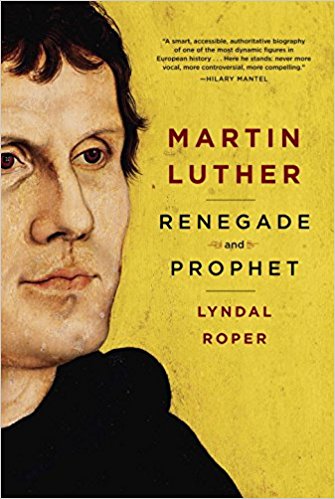
Martin Luther - Renegade and Prophet (Lyndal Roper, 2017)

(416 pp)

Martin Luther can't help but fascinate; it's the 500th anniversary of posting the 95 Theses; this book received favorable reviews; so it seemed like time to read more about him.  I much liked it.

(Initially nervous because the author tries to differentiate this bio from the massive stack of extant Luther bios by claiming a focus on "psychological" factors - ugh - but other than a bunch of references to Luther's father, and a passing reference to Freud, this element didn't much get in the way.)

What to make of Luther?  Certainly in the early going he appears clear-thinking, engaging, earthy; vaguely (very vaguely) reminiscent of Napoleon personality traits (or perhaps Napoleon is just top of mind these days).  Luther also adept at public relations - very impressive in Luther's case given the newness of print technology.  As far as PR - in addition to the printers, Cranach's shop churned out those memorable drawings.

Shows lots of courage in those early days ("here I stand") - this at a time when protection of his local "elector" wasn't necessarily a sure thing.  He stood up to the church hierarchy and Charles V.

Yes there were plenty of Germans sick of the Italians, and getting pushed around by local bishops; and the corruption in the central Roman Catholic structure was pretty overwhelming at this time (as discussed here).  So while Luther no doubt benefited from timing (again reminiscent of the Napoleon/"great man" discussion/French Revolution timing), it certainly seems that a unique individual was required to push reforms forward.  For starters, being put to death was a huge risk.

Author does a good job of explaining why Luther was such an unlikely candidate for what he did - modest education, grew up in what was then a backwater in Germany.

Some much less positive traits emerge if not predominate as the years go by.  Seems that the lengthy confinement in the castle - for Luther's protection - took a toll.  Deeply anti-Semitic.  "Protestants" (not sure when that term came into usage) were taking different paths; Luther seemed to rather like his first/supreme role, and as the years went by was never able to work very well with others.  Too often didn't even engage in useful discussions - just said "the devil" was driving his foes (reminiscent of how "racism" or "fascism" is used today).  Combative, insulting, personal. 

Also became pretty conservative - again, after the castle episode - realized he needed the elector and his ilk to survive - spoke out against the Peasants War, and generally advised submission to authority.  Which - coming from him - was rather rich.

Married a nun - a nice touch - several children - described as a loving father.

Lots of debate over the "Real Presence" issue in the Eucharist - many Protestants wanted to say it was symbolic, Luther kept insisting on a literal Real Presence.  Divisive issue, hard to now imagine how much energy was expended on this.

Enduring contributions in hymns, German translation of the Bible.

Luther dies in 1546.  Lots of bloodshed ahead.

Tuesday, July 25, 2017

The Sorrows of Young Werther (Johann Wolfgang von Goethe, 1774)

(110 pp)

Book club selection (via me; session held 23 July 2017).

Last read in 2009; my summary from back then still works well enough.

Biography of Goethe summarized here.

Discussion at session useful/interesting - partly as we wrestle with understanding blockbuster status when initially published.

Held the session at CPG house due to air conditioner failure(s) at ours.  PJ with some good cooking, including Grandma's peach pie.


Wednesday, June 28, 2017

The Proud Tower: A Portrait of the World Before the War, 1890-1914 (Barbara Tuchman, 1966)

(531 pages)

Unusual structure -Tuchman provides eight lengthy essays on various topics affecting England, France, Germany, Russia and the US in the two decades leading up to World War I.  The essays are related but not all that closely connected.  She writes really well.  I'd highly recommend.

Partly because - in addition to giving all kinds of perspective on that era - so much resonates with today.  Concerns about expanding the franchise - what would happen with additional voters, many less interested or informed than the limited group previously able to vote - will they vote themselves unaffordable benefits, fall for demagoguery, etc.?  Violence from the left, justified in various ways.

She doesn't believe - and shows - that the prewar "Le Belle Epoque" was nearly as great, or orderly, as nostalgia later recalled it.  So many making the exact error today when looking back at the 1950s.

The eight essays:

"The Patricians" - upper-crust England faces changes.

"The Idea and the Deed" - very good background on Anarchism - no interest in government; Proudhon, Bakunin; bomb-throwing (with consequences discussed at length in this book for the Balkans, also in this book for Russia; Joseph Conrad's excellent novel version here).  Gave me a little idea of where these folks fit in.

"End of a Dream" - the US builds up its navy, goes into Cuba and the Philippines - over the strong objection of those who felt this betrayed founding principles.  This is where Puerto Rico became ensnared.  Isolationism wasn't dead, but severely chipped away at - unfortunately.  I didn't know much about this story line.

"Give Me Combat" - France coping with the Dreyfus affair - added a lot of useful context to items recently read - more detail on the effect on French society.  Trump Derangement Syndrome resonates.  Multiple newspapers and viewpoints - unabashedly partisan - seems better than today's fake veneer of objectivity.

"The Steady Drummer" - discussion of Hague peace conferences.  Genuine fears emerging of mechanized warfare.  But the nations don't change course.

"Neroism is in the Air" - much discussion about German culture, primarily through Richard Strauss - also Nietzsche; a tale of rising militarism.  German intellectuals withdrawal tracing to 1848 failures and disappointments.

"Transfer of Power" - discussion of a topic I've wondered about - what process transitioned from aristocrats to more "modern" politics and parties?  Labour didn't exist as a party - Liberals prevail in 1906 with a few Labour seats; Liberal party on its way to oblivion.  More voters.  More literacy - more involvement - more perceived to be at stake - voters understanding that they can vote stuff for themselves.  Liberal disenchantment/disillusionment with Democracy, Enlightenment-style progress.  Rise of the mob.  Myth of rational voter.  The "transfer of power" in England, "not a mere political transfer from the in-party to the outs but one more profound, to a new class."

"The Death of Jaurès," - discussion of the birth of socialism - the splits among those expecting capitalism to fail (Marxian prediction) and those wanting to participate in the government and pursue changes via that route.

Tuesday, May 16, 2017

An Officer and a Spy (Robert Harris, 2013)


(425 pp)

Book club selection (via PJr; session held 14 May, 2017).

Book held up well on second reading; see discussion here.  Also a good book club selection.  Plus the beer selection was good, also chicken divan.