"To compensate a little for the treachery and weakness of my memory, so extreme that it has happened to me more than once to pick up again, as recent and unknown to me, books which I had read carefully a few years before . . . I have adopted the habit for some time now of adding at the end of each book . . . the time I finished reading it and the judgment I have derived of it as a whole, so that this may represent to me at least the sense and general idea I had conceived of the author in reading it." (Montaigne, Book II, Essay 10 (publ. 1580))

Showing posts with label Jewish. Show all posts

Thursday, February 05, 2026

The World of Yesterday (Stefan Zweig, early 1940s)

(389 pages) (passed along by Paul Jr)

Finish wasn't expected. Ended his days in South America in February 1942 (with his wife) - difficult to find a landing spot (as so many Jews experienced), cumulative burden of many difficult years and experiences during the world wars and interwar period, more factors than I can grasp.

The loss of his passport in the 1930s hit Zweig hard - like the Wandering Jews - a deep (and correct) feeling of no place to call home. Hard to imagine.

I didn't know much about him, just had very much enjoyed his novel Beware of Pity. He authored all sorts of interesting things - plays, articles - not so many novels (which I'm normally on the hunt for). Collaborated with big names for his plays. 

In the large group of Jews fully assimilated into Viennese society in early 20th century. Successes early as a writer got his name out there and he met an incredible number of famous names.  There was a lot going on in Vienna prior to World War I! He spent a lot of time abroad and particularly loved hanging out in Paris.

His works were completely banned in Germany by the Nazis. Including a libretto written for erstwhile Nazi favorite Richard Strauss.

His discussion echoed other books I've read about the momentous eras he lived through, just on a more personal level.  The golden years leading up to WWI (and disbelief that it happened). The WWI years.  The interwar years; the rise of Hitler; the seeming inevitability of WWII; incredible and increasing difficulties for Jews. That's a lot to live through. 

He was exposed to, and hung out with, an incredible concentration of high-end talent across many disciplines. Fascinating.


Wednesday, February 26, 2020

The Brothers Ashkenazi (I.J. Singer, written 1933-35)

(427 pages)

story takes place mid-19th century into mid 1920s

set primarily in Lodz; the town springs up from something of a village; much heavier Jewish concentration than most places; commercial and manufacturing center for textiles

Poland then part of Russia; Lodz merchants doing business throughout Russia; growth and change

twin Ashkenazi brothers - more detailed focus on Max - feverishly working to be #1 in the local industry (textiles); Jacob less talented, less intelligent, less diligent - but natural personality and physical gifts and unnaturally good luck

two other primary characters - Nissan and Tevye "The World Is Not Lawless" - work in local factories and seek to organize them; socialist speeches, Marxist dogma that would have sounded right at home in '20 presidential campaigns (complete with deeply religious strands)

all four leading characters working hard for entirely different things but in parallel ways and with similar results

all four leading characters from deeply Jewish backgrounds; changing but some retention

lots of character development including families of the four; earlier generation deeply traditional from the countryside/shtetl (typically relatively new to Lodz, it being a new town); Hasidic; rabbis with vast authority; this changes over time

some - certainly the Ashkenazi brothers - seek assimilation; not accepted but keep trying; as shocks such as economic downturn, war, inflation hit - guess who gets blamed

boom years in Lodz; then 1905 war with Japan; WWI; German occupation (shut down businesses, strip assets and ship west); Poles reassert themselves after Versailles treaty; part of the plot moves to Russia (during the 1917 revolution and thereafter - business couldn't be conducted during German occupation)

throughout - Jews tolerated to a point especially when useful, otherwise look out;

strand about considering Palestine

Buddenbrooks comparison, which makes sense

no way to assess accuracy - but much liked that Singer painted this detailed picture of what that world must have been like - the level of detail indicates he knew all about it

recommended - there's a lot going on here

Wednesday, December 12, 2018

The Story of the Jews - Belonging - 1492-1900 (Simon Schama, 2017)

(692 pages)

Second volume of a series; first volume is noted here.  These are well worth reading.

The ability of "the Jews" (which I'll treat as a single category even as I learn a bit more about differences within the category) to stick to their religious principles - and thus their separateness - is amazing, unprecedented.  Even, or perhaps especially, in light of what that "separateness" has entailed over the centuries.

This volume picks up with 1492 - expulsion from Spain.  Amsterdam as a relative haven.  Others escape east.  "Conversos" are treated, or mistreated, with great suspicion in Iberia; some defy restrictions on movement, capital flight.  These are referred to by the author as "Sephardic" - tend to be more educated on balance.  I don't know the exact definitions; he uses "Ashkenazi" more in association with central/eastern European communities - tend to be shtetl types, less educated, less able (or willing) to assimilate.  But of course so many exceptions.

He mentions a community in Kerala (Cochin).  Traders, connections, everywhere.

Western Europe consistently uncongenial - will use Jews for finance but turn on them as needed.  Amsterdam an exception.  Areas in eastern Europe - Poland, Russia, Bohemia - welcome Jews (needing their population and their skills) and surprisingly often follow through on commitments to leave them alone (not always, even in the best (most tolerant) of times).  Population expansion in these areas - eastern Europe as a major Jewish population center, who would have predicted this in Old Testament times?

Enlightenment - hopes rise - many community leaders pursue assimilation in hopes of avoiding mistreatment.    So many restrictions on occupations, where to live.  Always allowed to practice medicine - utilitarian.  Enlightenment era beliefs that if these occupational and residential restrictions are lifted, Jews will be more "normal" members of the community.  But the old hatreds appear irrepressible.  Alsace/Lorraine (Dreyfus territory) - ugh. 

This volume takes us up to 1900 - in late 19th century, hatreds are escalating again, as are efforts to secure a homeland.  It's little wonder that the latter strategy was pursued.

An embarrassing history for Christianity in so many ways.

Monday, June 25, 2018

In the Shadow of the Sword - The Battle for Global Empire and the End of the Ancient World (Tom Holland, 2012)

(473 pages)

Author's writing style is unusual - often it feels like rambling, but in the end it feels conversational.  And informative.

This book - focused on what we can call late antiquity - has a couple main threads.  The common theme is the rise of Islam just as Rome (eastern half ) and Persia dramatically declined.

One of the threads:  how did these previously "backward" Arab folk become perhaps the most successful imperialists of all time?  And so incredibly quickly?  Why did the existing power structures collapse so rapidly?  As also discussed in this very useful work - some key reasons included (1) Rome (meaning Constantinople) and Persia were duking it out for a protracted period just prior to the time of the Prophet, to the detriment (and exhaustion) of both; (2) Rome (still meaning Constantinople) was burning resources trying to salvage something in Italy and elsewhere in the West; and (3) severe plague struck both Constantinople and Persia.  Suddenly - centuries of global power were beaten down.

And those factors do not belittle what the Arabs accomplished - the success is astonishing.  Author suggests that the idea that warriors dying in battle will achieve paradise was pretty much new with Islam - is that so?  I'm not aware of it on a wide scale previously, though certainly the idea appears later with the Crusaders.  (Not the key to Islam military success in those days anyway.)

Another thread - author explores the history of the Koran and its related religious texts - and goes into quite a bit of detail (some admittedly conjectural) that suggests, pretty strongly, that there is less direct connection between these documents and what may have been the Prophet's words than one might think.  For example - it appears that quite a lot of this material was written a couple centuries after the Prophet - with decided social/political considerations no doubt informing the writers.

He compares to the Old Testament - for a long time ascribed to Moses - but rigorous OT analysis reveals multiple authors, much of OT written much later, much of it speaking to specific contemporary political-social circumstances.  Sources that might permit similar analysis of Koran etc. generally have not been made available (or may not exist).  Intense self-criticism applied to the Bible; pretty much no culture of self-criticism as applied to Koran.

Oldest materials apparently don't emphasize the Prophet and raise questions about relative significance of Mecca/Medina; geographic sources seem to lie elsewhere (many farther north); it seems there was more borrowing of religious ideas than might be acknowledged if one wants to hold the position that everything was dictated to the Prophet by an angel (Gabriel as it turns out).  Discusses how Arabs were retained as mercenaries for both Roman and Persian, picking up lots of ideas (and serving in the north of the peninsula).  Jerusalem as an unlikely place of significance for Islam.

It's interesting to think about how religions get started - charismatic founder not writing things down; then the process of defining the religion plays out over a long period of time.  Christians fractious about theological details - Jesus certainly defined very little - but then with a Constantine - he can start ordering folks around - all of a sudden you have a Nicene Creed (325) - not that this ended the debates, but a structure was emerging after centuries.  Islam, Jews not really the same with this; author describes groups of scholars that develop materials (also centuries later!) and eventually gain control of the story (i.e. ultimately define the religion) - this is interesting if challenging to pin down.  Role of caliph in those days - combining temporal and spiritual leadership - confuses me.

Islam born in an atmosphere immediately permeated with local struggle/war and immediately expanding outward in an environment of conquest/war; and then needing to deal with handling subject peoples.  Christianity born with society's losers and core doctrines didn't get established from a war/conquest viewpoint; the warrior/imperial aspect really didn't launch until Constantine (312) (unfortunately it then seeped into the doctrinal).

And that is not to belittle the contents of the Koran or the Bible - these are pretty wonderful works no matter the provenance - it does suggest that it might be prudent to be a little less dogmatic on their contents!

Sometimes these "late antiquity" centuries feel rather lost . . . but there is lots of action . . . high points such as Constantine 312, Fall of Rome (in the west) 476, Hejira 622 . . . leading right to Tours 732 and Charlemagne 800 - and on it goes.

Tuesday, November 28, 2017

Bewilderments - Reflections on the Book of Numbers (Avivah Gottlieb Zornberg, 2015)

(311 pp)

Religion pretty clearly has been crucially important throughout history, and I need to know more about it.  On the Judaeo-Christian side - have pretty well made it through a re-read of the Old Testament (mostly skipping the wisdom literature), including the Pentateuch.  Saw a favorable review on this author's deep dives into the Old Testament; this one focuses on the Book of Numbers.

I didn't love it, and will take a break before picking up more of her work (if I ever do).  I expected to appreciate the deep dive aspect - but often it felt as though the author was straining to find meanings and subtexts, perhaps to fill out a book-length effort (actually a lecture series turned into a book)?  Or perhaps I just don't get it.

I was bewildered, so to speak.

The Book of Numbers takes place after the Jews have been delivered from Egypt; they are rather grumbly and some even express a preference to return.  The Spies check out the Promised Land but suggest great problems overcoming the locals.  God decides that the Jews will wander in the desert for 40 years - ensuring that all of the faithless will be buried in those sands - a new generation will finally reach the Promised Land.

Not including Moses - the 2x rock tap episode gets a lengthy, and quite different, treatment here (including speculation that he was supposed to "speak" to the rock in front of the people).

I learned something about Talmud and midrashic sources, which was interesting.

Miriam - song/dance.  Joshua. 

Thursday, April 27, 2017

The Lost Book of Moses - The Hunt for the World's Oldest Bible (Chanan Tigay, 2016)

Entertaining and useful - but for my taste, way longer than it needed to be. (332 pages)

Book focuses on Moses Wilhelm Shapira, who in 1883 showed up in London with what he claimed was the world's oldest Bible scroll.  Rejected as a fraud - but when the Dead Sea Scrolls are found some 70 years later, the authenticity issue is reopened.  But by then no one knows where Shapira's scrolls ended up.

Shapira as an unlikely antiquities vendor - based in Jerusalem in second half of 19th century.  Problems with his sales of Moabite pottery.  His shop in the old city is a mecca for tourists - tourism being rather a new idea in Jerusalem in those days.

The author gets into long discussions of his detective work in trying to track down the scrolls - well-written, clever - but really who cares?  (I guess it did give some insight into how these artifacts - accumulated starting in 19th century - end up more or less lost or findable, as the case may be, in museum boxes - the fate of so much stuff, apparently.)

An interesting angle:  the discussions, if short, about the history of the Bible - Shapira's heyday overlaps with the first scholarly analysis of the development of the Old Testament.  Interesting to think that, until this time, so much rock-solid belief that e.g. the 10 Commandments were written on tablets by finger of God, etc.  Religion changes a lot if one considers that the foundational texts might be affected by the hand of man (similar strands with Mormon texts, also Islam).

Jerusalem's history so interesting - like so much of that part of the world, conquerors sweep through from time to time over the millennia - so in that sense, lots of conflict.  But when Shapira is active - 19th century - Jerusalem is coming off a period of relative neglect - no sign of the three-way fight among Christians, Jews, Islam that - here in 21st century - one would assume has been going on for centuries.  But to get started on that topic, I'd recommend this book.

Wednesday, April 19, 2017

The Fixer (Bernard Malamud, 1966)

A ne'er-do-well "fixer" (someone who makes a living, sort of, as a handyman or doing small repairs) reluctantly moves from the shtetl - embarrassed that wife left him, looking for change - to Kiev.  Early 20th century.  Fixer uneducated but finds an interest in reading, picks up quite a bit of learning here and there (Spinoza).  Chain of circumstances leads him to reside and work, under a false name, in an area forbidden to Jews.  Christian child is murdered with multiple stab wounds; the fixer is arrested for ritual murder.

Malamud wins Pulitzer Prize for fiction for this novel.  I liked it.  Consistent with discussion of anti-Semitism in Russia as discussed in this review of the Romanov dynasty.  Belief in things like the forged "Protocols" even among the supposedly educated upper classes - in the 20th century.

I read that Malamud considered writing a novel about the Dreyfus affair (novel form here; history focus here) - certainly plenty of overlapping elements - but settled on this instead.  Prejudice, maltreatment in prison, entrenched institutional forces, false witnesses, emerging community support.  (Malamud's novel is based, pretty closely as I understand it, on a true story.)

Author has an interesting way of describing what the protagonist felt while imprisoned for a prolonged period awaiting indictment and trial.  Wife visits him in prison.  Father-in-law (Shmuel).  Conversations with an honest investigator, and later with his lawyer - author uses these as devices to lay out some history on Russian pogroms.

262 pp in this edition.

Tuesday, October 18, 2016

The Wandering Jews (Joseph Roth, 1926-27)

Knew nothing of Roth other than the marvelous The Radetzsky March until recently reading this one, which suggested more Roth would be worthwhile.

This work is quite short; non-fiction - an account of the plight of displaced Jews - primarily leaving eastern Europe in the aftermath of WWI.  Roth was from Galicia and understood the challenges and mistreatments of the unassimilated Eastern Jews (not that it was that great for other Jews).  Poverty; odd jobs to scratch out a living; the challenges of being the "other".  Just comes up again and again, century after century.

Very interesting that Roth is writing this in the 1920s - that element is rather unique - he seems to have a realistic view of the problems ahead (even if he couldn't have predicted the awful turn events actually took).

A bit of an apologist for Russia, as so many were in those days (I think understandably); seems to get a little fuller viewpoint as time passes.


Saturday, September 24, 2016

Ostend - Stefan Zweig, Joseph Roth, and the Summer Before the Dark (Volker Weidermann, 2014)

Book was well reviewed (and short).  Somewhat interesting items about important authors.

Main focus is on Stefan Zweig and Joseph Roth (and their longstanding relationship).  Zweig had been at a resort on the Belgian seaside (then known as Ostend) when World War I broke out - interesting descriptions of the excitement, the sense of national unity in summer 1914 (reminded of the false, or at least ephemeral, feelings around 9-11 in this country back in 2001).  Zweig, Roth and others were back at the same resort during a summer in the 1930s - had been kicked out of Germany and banned from publishing there (their main business and financial lifeline) - because of Jewishness, and/or writings that didn't satisfy Nazi censors.  Spanish Civil War breaks out.

Zweig as cultured, successful, assimilated Viennese-based Jew; Roth as Galicia-based - this distinction seems to come up a lot.

Interesting stories at Ostend - but not all that interesting.  In a way it reminded me of this Hemingway novel - expat types struggling and carousing.

Zweig wrote this really fine novel (started working on it during the time period covered in this book) Roth was famous for this really fine novel; they run into Arthur Koestler (still enamored with Communism, so a bit before he wrote this book).

One of my favorite authors - certainly a famous expat in those days - did not show up at Ostend that summer, but apparently he was a regular topic of conversation, and at least one of his children did.

Sunday, July 10, 2016

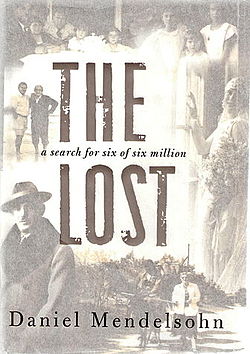
The Lost - A Search for Six of Six Million (Daniel Mendelsohn, 2006)

Wasn't really looking for *another* Holocaust book.  But PJ was recommending this pretty strongly, so I thought I'd be a good sport and take it up.

Very glad that I did - some perspectives that I found quite unique.


The author is a professional writer - NY Review of Books, NYT magazine, that sort of thing - and became deeply interested in history even as a child, he thinks due to influence of his grandfather.  Family origins in Bolechow, Poland; many emigrate as things get tough; six stay behind and disappear as Germany takes over following Hitler turning on Stalin in 1941.  Limited and not always consistent information is available about how the six were liquidated, but author decides to search for more.

Travels to Bolechow; then Australia, Israel, Scandinavia.  Reconnects (or connects) with photographer brother who seems to do very nice work (wish the photos had been given more prominence in the book).

Author uses a meandering storytelling style - takes some patience - 503 pages - but well worth it.  Interactions with survivors; some pretty amazing coincidences enable information to be discovered; very powerful as author descends into the kestl.

Particularly useful to me - he pulls together threads I'm pursuing - family history research; weaves Old Testament stories (particularly Cain & Abel, Noah, Abraham), along with interpretations from two Torah commentators, into his narrative; Jewish history in eastern Europe; stories of the Polish borderlands (Galicia), last flickering remnants of the old Habsburg days; plenty of tension among Poles, Ukrainians and Jews but at least they could live together and function for the most part (other than the occasional outbursts, which were awful enough).  Jews now all gone.

The awful episodes during the several Aktions, including at Dom Katolick. Hidden in a teacher's house.  Polish boy makes the mistake(?) of falling for a Jewish girl.  Uncle Shmiel loses his permit to run his truck.  Stuff that happened with Jews under 1930s German diktats (with plenty of local collaboration) - wow.  Ukrainians take advantage.

Searching for the personal detail that prevents - ok, only delays - a person (pretty much every person, ultimately) from being entirely, utterly forgotten.  Searching for how it might have felt (not just how it happened).

Author states that his grandfather was renowned for his storytelling ability, and he tries to describe his grandfather's method; then describes his dilemma about how to shape the story he is learning about in his researches . . . of course he's signalling that he will be using his grandfather's method to tell this tale.  Which he does, very effectively.

Friday, August 28, 2015

Dreyfus - A Family Affair: 1789-1945 (Michael Burns, 1991)

Another - and highly interesting/effective - take on the Dreyfus story.  This author provided a significantly broader view of the situation than anything I've previously read, well worth it.

A highly useful part of the background included Dreyfus family history going back to their days in Alsace and beyond.  In terms of Jewish experiences, very complementary to this book (which by coincidence I was working through at the same time).  Anti-Semitism intensifying as 20th century dawns - almost unbelievable, except that it somehow continues to this day.

Dreyfus family intensely patriotic notwithstanding everything - true believers in the ideals of the Revolution (if grievously tarnished).

It's really a truth-stranger-than-fiction situation - hugely interesting, very helpful in thinking about the 20th century.  Defining for France, etc.  No wonder folks like Proust were so focused - everyone was.

One other reaction:  the recent historical fiction version was really quite well done.

Wednesday, August 12, 2015

The Story of the Jews - Finding the Words - 1000 BC - 1492 AD (Simon Schama, 2013)

I need to know more on this topic, but was a bit reluctant to pick up this book as it is linked to a PBS TV series.  But not to worry - very readable, full of useful information, changed my understanding on a number of topics.  So I hope the author is credible.

Worth paging through multiple times.  A key takeaway - like other religions, this one is continually writing and rewriting its own history based on needs or objectives of leaders in various situations and geographies.  Meaning:  don't assume anyone's pronouncements are dispositive.

Author goes through biblical times, then into New Testament; the strange, and sad, manner in which persecutions flowered.

1492 is a logical breaking point given events in Spain, I will look forward to the next volume.

Thursday, October 16, 2014

If This is a Man (1947) | The Truce (1962) (Primo Levi)

Levi was an Italian Jew - a chemist - deported to Auschwitz.  Survived, and made it back home to Turin.  Felt a need to write down his experiences - not previously an author, but all this seemed to turn him into an effective writer indeed.

Much of the power here is that he was not writing for a commercial audience in 1947.  As this belatedly helped me understand, the "Holocaust" as a concept didn't exist - and wouldn't for many more years.  Levi simply recorded, without hatred, his vivid recollections of surviving in Auschwitz.  To help himself think it through; to record for others.  Spare, non-dramatic - and therefore excruciating.

Here in 2014, have we "heard it all before"?  Yes - but I'd say Levi's book - as a first-person account written very shortly after the war - is in a class by itself.  And worth reading no matter how much other material of this sort one has previously read.  His detailed descriptions of the markets going on in the camp (and involving townspeople) were new to me.  The dreaded "selections."  Cold, hungry, degraded.

Also interesting in respect of the camps:  the large number of countries represented among, and languages spoken by, the prisoners.  Levi encountered several Italians (and a few others) who were crucially helpful allies.

He was one of a handful of survivors out of the 500+ deportees in his group.  Survival aided in part by his skill set - as a chemist, he was assigned to a lab and avoided some of the harsh outdoor work as his second winter in the camp set in.  Also was lucky to be very ill at the time the Russians liberated the camps, as he was left behind in sick bay while the Nazis dealt with many of the other prisoners.

"If This is a Man" didn't find an audience for a number of years.  Levi wrote a number of books after it.  After "If This is a Man" caught on, he wrote a companion piece - "The Truce" - recounting his long journey from Auschwitz back to Turin.  The Russians were in charge of most of the trip, and his stories of the journey are consistently interesting.  It was the days of "displaced persons."  I particularly liked his description of how it felt to pass through Germany on his way back to Italy.

His story is truly amazing (the cliche actually applies here).  PJ recommendation.

Tuesday, July 15, 2014

The Pianist (Wladyslaw Szpilman, 1945 (translation 1999))

Book club selection (via PJ).

Hadn't realized the quite-fine movie of the same name was based upon a book by the protagonist.  And it's interesting that - for once - the movie pretty much tracked the book.

Szpilman was a pianist for Polish Radio in the run-up to World War II; he was playing a Chopin Nocturne on the air when the Germans knocked out the station.  There followed the awful times for Warsaw Jewry (Polish situation described here, for example).  Establishment of Warsaw Ghetto; systematic reduction of the population; random violence; overcrowded conditions leading to illness, starvation, misery.  He recounts the scene in the train yard (also in the movie) where his father purchased a black market overpriced chocolate and cut it into six tiny pieces - the last family meal.

Very spare writing style, which I think was also very effective.  Hard to believe the author - with all the challenges simply to survive - was able to put this together in 1945.  It generally was suppressed for decades thereafter.

The friendly German is an interesting character - very helpful to have his diary extracts at the back of the book (also the epilogue).  Some discussion whether the diary extracts were somehow written after the fact, but I rather doubt it.  Still, would have been mighty dangerous for the diarist if his musings had fallen into the wrong hands.

Another reminder of the sorry opportunism of local populations - often crueler to the Jews than the Germans were (which is saying a lot).  The incredible risks taken by those willing to assist Jews.

Szpilman played the same Nocturne as the first broadcast on Polish Radio following expulsion of the Nazis.  Pretty amazing story.

Friday, May 09, 2014

The History of Love (Nicole Krauss, 2005)

Book club selection (via Nick).

One of the advantages for me of this little "book club" is that I am forced to read stuff I otherwise would not select - such as modern fiction.  This book fits that category, and was worth reading.  Even if it didn't entirely fit together (or maybe I just didn't follow well).

Young Jewish lovers in Poland; the guy (Leo) writes a book ("The History of Love") to/for his girlfriend (Alma); Nazis close in and Alma (pregnant though this is unknown to Leo) goes to America; Leo goes into hiding in Poland; Alma ends up marrying son of owner of business where she works (concluding Leo must be dead and the kid needs a father); Leo eventually makes it to America, learns of Alma's situation, watches Alma and his son (who became a famous writer) pretty much from afar; takes up locksmithing via Polish contact; does a little more writing; grows old in obscurity.

The manuscript for The History of Love was entrusted to Leo's childhood friend in Poland; he emigrates to South America and eventually publishes it in Spanish in a limited edition under his own name (also thinking Leo was dead); and gained some notoriety thereby.  A key character is a young girl named Alma (after the lead character in Leo's book, which book was beloved by the parents of Alma #2); she has an annoying brother nicknamed "Bird"; their father had died young; Alma #2's efforts to be a matchmaker for her mother lead her to research the origins of her name, which process brings elements of the story into focus.  Finally.  Somewhat.

Story is told through several narrators and bounces around in time and geography.

Best parts of the work were written in Leo's old-man voice.

Monday, February 17, 2014

The Merchant of Venice (William Shakespeare, between 1596 and 1598)

Continuing to work my way through Shakespeare's plays.

I read this in short chunks over the course of a few months, so perhaps lost the flow.  But I didn't like this as much as Julius Caesar or Richard III, when I thought I remembered liking it quite a bit.

Shylock - the avaricious Jew - yet given perhaps the best speech in the entire play ("Hath not a Jew eyes?").  Fuel for anti-Semitism; but it seems to me that Shakespeare had a more nuanced view.  (I do like the use of this speech in Ernst Lubitsch's movie "To Be or Not to Be").

Always interesting, but mostly saddening:  the incredible continuing definition of the Jew as the "other", or the "outsider".  And not just in Christian Europe - I suppose one could carry this story back to the book of Exodus, to the Babylonian Captivity, to any long list of occurrences.  Not clear how much this particular viewpoint is shaped by the formation of the State of Israel in 1948 - seems like "not much."  Amazing, frustrating, how little things change.  What's up with this?

Usury as a flash point in those days.

Portia with her famous - and really, quite lovely - speech about mercy.  "The quality of mercy is not strained:  It droppeth as the gentle rain from heaven Upon the place beneath.  It is twice blest:  It blesseth him that gives and him that takes."  [etc.]

Then, in disguise, she switches to some fancy legalese.

Shakespeare = so worth reading.

Monday, January 27, 2014

I Kiss Your Hands Many Times - Hearts, Souls and Wars in Hungary (Marianne Szegedy-Maszak, 2013)

Author's parents and grandparents came through difficult times in WWII Hungary.  Author, growing up with extended family in NY, had limited understanding of family background until she arranges translation of stacks of letters after her parents died.

I've read lots of WWII stuff - but the story that she frames is one of the most interesting and unique of all.  Partly because it is centered in Hungary - relatively safely away from the fighting until the last year of the war (which I had never thought about).  And Hitler had enough other things keeping him busy such that he didn't put the hammer down on this semi-reliable ally until late in the game.

"I kiss your hands" - a traditional Hungarian departure gesture, also used in the closing of letters.  Aladar - typically guarded in his communications - expressed a bit stronger feelings toward Hanna by adding "many times" in closing letters to her.  Nice.

A few of the threads running through this:

1.  Author's father - Aladar - rising political star in Hungary, from a Christian family.  Encounters Hitler in a couple settings while on government business.  Pretty outspoken against Nazis - which naturally enough didn't help him at certain points in the story.

2.  Author's mother - Hanna - belongs to a Jewish family - incredibly successful business operators, supposedly their operations constituted about 10% of Hungary's GDP (hard to believe).  Wealthy, aristocratic, assimilated, some converted to Christianity - but still, Jews.

3.  As Aladar and Hanna fall in love, anti-Semitic legislation makes the match nigh-impossible.  Hungarian government goes slow on attacking Jews; Nazis finally force the process in 1943 or 1944; too many Hungarians were way too glad to assist.  The Nazi Jew-killing machine was in top condition at this point, and - with plenty of local assistance - murders of Jews in Hungary were accomplished with incredible efficiency.

4.  As the Nazis advance and then, in short order, the Russians start to attack - Aladar ends up in Dachau.  A political prisoner of the Nazis.  Awful experience; he's there when the U.S. army arrives.  Budapest itself badly wrecked, including blowing up beautiful-historic Danube bridges.  The war finally hit home in Hungary with full force.

5.  Prior to Aladar being taken away:  Hanna's family is bargaining with a Nazi - in a deal that was approved by Himmler himself - family members already in camps are released and with most of the rest are allowed to emigrate to Portugal.  In exchange for most of their assets.  Though with a few hostages left behind to make sure the rest behave once outside Hungary.  Aladar not aware of how this is turning out.  (Author explains why Nazis didn't just steal the assets, something to the effect that they were still putting up a show of limited interference with their allies.)

6.  Very touching story in the immediate postwar era - Aladar and Hanna reconnect.  Married in the wreckage of Budapest.

7.  Pretty much immediately after the war, Aladar (still highly thought of) is appointed by the new government to be ambassador to the U.S. - so he and Hanna move to DC.  Hopes for democracy.  Hopes for U.S. intervention.  But the Communists take over Hungarian government in their typical 1940s-thug-style as applied throughout Eastern Europe.  And the U.S. had other priorities - Hungary pretty clearly a lost cause in terms of Soviet domination.  So Aladar is out of a job.  And returning to Hungary is not possible.  But his in-laws start showing up, and they still had both money, and business smarts.  So no danger of missing meals.

8.  Aladar - something of a nervous personality - didn't thrive in the wake of all this.  Not surprisingly.  Did work for Radio Free Europe and Voice of America in relation to Hungary.  It was effective that the author didn't sugarcoat his problems.

9.  The quoted correspondence is pretty amazing throughout.  Hard to imagine educated, articulate folks writing to each other in these circumstances.  Quite wonderful to read.

Author didn't realize until it was too late:  but her parents had quite a love story under truly extraordinary circumstances.

The above doesn't do justice to the book.  I dog-eared dozens and dozens of pages - lots of ideas about history, and just plain nice moments, that I want to keep track of.

Sunday, September 29, 2013

To the End of the Land (David Grossman, 2010)

I've had this book on my list since seeing several very positive reviews back when it was published in 2010.  By happenstance, my reading of it coincided closely with two closely related works (described
here and here).  Which helped make this one more meaningful.

Ora is the lead character.  Her son (Ofer) is finishing up duty in Israeli military; to celebrate, they were planning a backpacking tour up north in Galilee (estranged husband Ilan and other son Adam are out of contact somewhere in South America).  But Ofer goes back into the military in relation to an initiative underway in response to Palestinian unrest.  Ora is freaked out, let's say, and decides that she can protect Ofer by getting out of her home, avoiding news, and becoming invisible to the military's "notifiers" that come around and tell families that their sons are dead.  Ora knows this is somewhat beyond irrational but does it anyway.  And she recruits a formerly close friend of both she and Ilan - Avram - who has some issues, let's say (mostly stemming from being tortured as an Egyptian POW during the 1973 war - a situation to which Ora and Ilan are connected).  Anyway off Ora and Avram go, with backpacks.

I very much liked quite a few elements of the story.  The first part - when Ora, Ilan and Avram are quarantined in a barely functioning hospital during the 1967 war - is really nicely done, imaginative.  The parts dealing with Ora's relationship with Arab chauffeur, Sami, are most interesting.  Those folks need one another, but the circumstances are unimaginable.  

I think the book also gives a glimpse of the overriding sense of precariousness that must be quite real in Israel - especially for the generation that went through the near-existential moments in 1967 and 1973.  How must it feel to live in a tiny country pinned against the sea, surrounded by much larger countries many of which have sworn to wipe you out?  And relying on America politicians?

Ora rides the bus when bombings are taking place - good description of the way people avoid looking at each other, clearly mistrustful.

The ending caught me by surprise.

Only criticism:  I think the author overdid it in shaping characters who seem to live so intensely that it is almost "too much," for want of a better description.  The book didn't need this, it was strong enough with less intensity of that nature.

Recommended.

Thursday, August 29, 2013

Jerusalem - The Biography (Simon Sebag Montefiore, 2011)

Book had received glowing reviews - and clearly deserved them.  This is one of the more helpful things I've read recently.  Bought it. Will use it for reference.

Author is a descendant of one of the leading Jewish families in Jerusalem (his great great uncle plays a prominent role).  Author - I hadn't heard of him previously - apparently he is known for writing popular histories.  But in his case this is a plus - as best I can tell, he's managed to write useful, balanced books that also are highly readable.

Jerusalem is a relatively small, remote town.  That somehow became ground zero for the three Abrahamic religions.  The history is simply unbelievable.

Hopefully any government official with any decision-making authority about sending Americans into this part of the world will have read this book carefully.  (And plenty of other materials.)  The issues run deep here in ways we cannot really fathom.

I like how he handles the Old Testament era - it's interesting how archaeology continues to confirm some of the Biblical figures (plenty others remain in myth-status).  David.  Assyrians, Babylonians, Persians.  Herod.  Paul of Tarsus - labeled "The Creator of Christianity" here - which is a pretty interesting thought.

Muhammad's seemingly tenuous connection to Jerusalem.  Turned into something big.  Crusaders.  Byzantines.  Richard the Lionhearted.  Saladin.  Ottomans, and periods of obscurity.

Napoleon's ill-fated Mideast tour spawns bestsellers and renewed Western interest.  Christian evangelicals - many in U.S. - see linkage to the last days.  Russians pour in.  Mark Twain.  WWI, Zionism.  1948.  1967.

Useful discussion how the Christians, Muslims and Jews all have so many sub-sects floating around, often at odds with each other.  The conflicts aren't just among the three major strands.

A city absolutely unlike any other.

Wednesday, February 15, 2012

When They Come for Us We'll Be Gone - The Epic Struggle to Save Soviet Jewry (Gal Beckerman, 2010)

This book was more interesting than I expected.  Maybe one of the big surprises was how much we (or at least "I") am already forgetting how amazingly different the world was just a little over two decades ago (the Berlin Wall came down only in 1989). 

I had heard about much of this in the media, in the later years of this struggle, but didn't have a clue how the story fit into other historical themes.  And pretty much forgotten it all.

The story line here is that three million Jews remained in the Soviet Union after World War II.  Stalin distrusted them; part of the general theme of crushing any non-standard behaviors.  And also wouldn't let them emigrate - this would signal that the classless workers' paradise perhaps wasn't all it was cracked up to be.  An odd existence ensued.  These folks were often highly educated, with important jobs.  And typically not actively persecuted - just prevented from being Jews for all practical purposes.

Some started to push back.

And it's hard to recall, or believe, that folks like this were hounded by KGB agents and shipped off to the gulag such a short time ago.

The author feels that U.S. Jews were much ashamed of not doing more during the Nazi years, and also looking for ways to affirm "Jewish-ness" (however one should word that) after achieving great material success in the U.S.  Somehow they got onto the Soviet situation - often led by a Cleveland synagogue.  This led to organized politicking by Jews in new ways.  And elevated an issue that otherwise probably would have gone nowhere.

The situation in the Soviet Union was complicated - some Jews were interested in politics and emigration, others in providing a way for Jews to learn about Judaism in a situation where the authorities blocked or interfered with learning.  Others didn't care much.

And Israel was highly interested - the Middle East demographics always were daunting, and Israel viewed Russia as a great source for increasing its Jewish population.  Sought to have emigres routed to Israel.

As discussed in this book - the Holocaust per se didn't come much to the public attention until the Eichmann trial (which I understand makes good viewing on YouTube these days).  These triggers led to the U.S.-based efforts (per above).

The complicated relationship between Jews and blacks in the civil rights era.  The way the Helsinki accords (human rights provisions) backfired on the Soviets.  U.S. politicians - Kissinger, Nixon, Scoop Jackson.  Protests in NYC.  Refuseniks in Russia.  Anatoly Shcharansky.  Trials.  Internal exiles.  Chernobyl disaster as a confirmation of the rotted Soviet state.  Andrei Sakharov.  Gorbachev.  1989. 

It really is an interesting story, very helpful in looking back at the era.