"To compensate a little for the treachery and weakness of my memory, so extreme that it has happened to me more than once to pick up again, as recent and unknown to me, books which I had read carefully a few years before . . . I have adopted the habit for some time now of adding at the end of each book . . . the time I finished reading it and the judgment I have derived of it as a whole, so that this may represent to me at least the sense and general idea I had conceived of the author in reading it." (Montaigne, Book II, Essay 10 (publ. 1580))

Showing posts with label Asia. Show all posts

Monday, December 07, 2009

Plain Tales from the Hills (Rudyard Kipling, 1888)

As with The Light That Failed, I read this as a result of working through Kipling's biography.

This book includes a series of short stories that were published in some British newspaper that served the expat community in the 1880s. Kipling was widely praised for his originality; had a good feel for the interaction between the communities based on residing there as a child.

Entertaining. But I didn't find this terribly interesting either. Quit about a quarter of the way through.

Friday, October 30, 2009

The Man Who Would Be King - The First American in Afghanistan (Ben Macintyre, 2004)

This book seemed interesting as backdrop to the continuing adventures of the U.S. in Afghanistan, and fit into other books about the region I've been reading.

Some American named Josiah Harlan headed for Central Asia in 1822 or thereabouts. After knocking around in a few British outposts, he somehow had the idea of emulating Alexander the Great, or at least finding wealth, fame and perhaps a kingdom in the area of Afghanistan. Somehow he made it work, all the way to being named a prince of an area known as Ghor.

This was in the early days of adventuring in the region; the British were developing interests in the area, and developing concerns with Russian intervention (this contest later to be known as the "Great Game").

Somehow Harlan gained trust and familiarity with key figures; was involved in rebellion; easily switched sides; mixed with leading figures in Kabul; eventually was eased out of the country by the British.

The book recounts the British disaster in 1842; they underestimated the Afghans. But then again Alexander the Great and the Soviets had troubles in this area also. The painting at bottom shows the remainder of the British army returning to Jalalabad.

The British would have been better served with Harlan's philosophy: gain some trust, or at least heavily bribe, the local chieftains.

Rudyard Kipling wrote a famous novel based on Harlan, named "The Man Who Would Be King." I hadn't known that Sean Connery starred in the movie version.

Harlan himself came back to the U.S.; (tried to) fight in the Civil War; (tried to) introduce camels into the southwest U.S. Interesting fellow.

Friday, September 18, 2009

The Ottoman Centuries (Lord Kinross, 1977)

Trying to get better acquainted with this part of the world, and this book was helpful. And most interesting throughout.

Seljuks were supplanted by Ottomans - around 1300. The Muslim conquering waves - starting from Arabia around 700 and working up into Spain, east into Persia, etc. The Arab wave then slowing and consolidating; Ottoman wave coming on. Mehmed the Conqueror; Suleiman the Magnificent.

The story reminds of the Roman Empire in some ways - hardy military types with tolerant government that works very well in expansion mode. Osman's descendants figured out how to settle down and govern. Strangling rival brothers seemed to add stability. The Janissary corps was quite an idea - rely on highly trained Christian slaves, prevent local nobles from building competing constituencies.

Finally took down Constantinople in 1453. Took control over much of what we refer to as the Middle East, much of the Mediterranean. Seems like the Persians could maintain quite a bit of autonomy, benefitting from distance.

It's interesting to think that the Balkan populations and Eastern Europe were bouncing back and forth - Roman, Eastern Orthodox, Russian Orthodox, Muslim. The Ottomans were regularly pushing up through Hungary, fighting folks like Vlad the Impaler (a model for Dracula). Ottomans controlled Bosnia, Croatia, Serbia, Hungry, etc. for a long time. Ottomans pushed up to Vienna as late as 1683 (Poland's Jan Sobieski was a hero; and Vienna had coffee shops for the first time as the Ottomans left huge stores behind as they fled).

The downhill slide lasted a long time. The Janissary were like the Streltsky or other palace guards - too much power, too many demands, no Peter the Great to take them out. Sultans spent too much time in harem. An attitude that there was nothing to learn from inferior westerners - an attitude that initially had some basis, but became increasingly inaccurate over time.

Some of the problems sounded so typical - large intractable bureaucracy sucking the producers dry. In later centuries, competing interests from Russia, France, Britain. Interests in maintaining the "sick man of Europe" for balance of power purposes. Armenian genocide. German influence into World War I; Ataturk; some very serious efforts to modernize and reform, one can see the genesis of the secular state (so rare in that part of the world, fragile even now).

The book touched on Lepanto and the cultural progress described in this book.

Thursday, July 09, 2009

The House of Wisdom - How the Arabs Transformed Western Civilization (Jonathon Lyons, 2009)

Great follow-on to two books just completed (here and here). Though per my usual reading approach this takes place by happenstance, not planning.

As I keep reading, this era becomes somewhat less cloudy. This book was very helpful.

Quickie chronology items (no particular significance other than they help me keep things in a bit of order):

312 - Constantine/Constantinople
476 - "official" collapse of Roman empire in the west
632 - Mohammed dies
732 - Islam expansion into Europe via Spain halts at Tours; Islam in Spain develops as a somewhat separate branch (al Andalus) (Islam also had expanded (and continued to expand) eastward, including ancient civilizations such as Persia and India)
762 - Baghdad founded - "House of Wisdom" (the subject of this book) founded shortly thereafter - bringing materials from Greece, Persia, India
800 - Charlemagne crowned
[1066 - Battle of Hastings, Vikings had traveled 'round, including southern Italy and Sicily]
1095 - First Crusade called
1100 - Adelard (major early figure in this book) travels east to learn from the Arabs
1270 - Thomas Aquinas (trying to reconcile faith and reason as these issues become more combustible with the spread of learning from Arab sources etc.)
1277 - Catholic church issues another detailed ban regarding various teachings (faith v. reason issues etc.) (this goes on much longer)
1453 - Constantinople taken by Ottomans
1492 - the "reconquista" is completed, Islam is out of Spain (and guess what, the dynamism diminishes rapidly into a super-conservative model, especially when the Jews were also later kicked out)
1517 - Luther's 95 Theses
1543 - Copernicus publishes
1571 - Battle of Lepanto
1633 - Galileo convicted
1683 - Battle of Vienna (last big push up the Danube by the Ottomans)

So what was up with these Arabs? Unbelievable energy; even if there was a power vacuum following Rome's collapse, the territorial conquest in ~100 years is unbelievable

And these were folks who previously had lived incredibly simple lives in the desert.

On top of the conquests, they actively sought to gather learning from areas with far deeper histories (India, Persia, Greece); to understand; to build. Luckily, they didn't have theocrats halting studies in those days. (Plenty in the West at the time.) Though it sounded like there was developing tension already in the Muslim world between religion and science.

Story lines:

1. Consistently low level of learning in the West. Lost access to classics after centuries of barbarian invasions, Muslim territorial grabs. Augustine set the tone - not much to learn beyond faith. (Can hear echoes of blind Jorge from The Name of the Rose to exactly this effect.)

2. Roger of Sicily - open to Arabs (like Lepanto books, can see where these Italian states prospered during these years, including Genoa, Florence and Venice)

3. Medicine, Euclidean geometry, Ptolemy, Aristotle, etc., etc. - the Arabs worked this stuff over, hard. (Even if for astrology (a traditional Persian focus) and alchemy to a significant extent).

4. Translators - including Averroes - constantly referred to in The Name of the Rose as a threat to Western church leaders - brought Aristotle to Europe. Averroes also did extensive commentaries, not just translations.

5. Cathedral schools transition into early universities; not much impressed by orders from church authorities to stop studying various topics.

6. Helped get a glimpse of how learning proceeded under Arabs, stagnated in the West, how a few individuals started the cross-pollination that became a flood.

7. That Muslims - though at odds with the West on various - weren't systematically demonized until the politicians and churchmen needed this for the First Crusade. Like most of these situations, demonizing wasn't applicable for those living on the boundary areas; they interact, trade, learn, etc.

8. With all the learning derived from Arabs - the West apparently later sought to suppress this heritage, instead claiming direct learning down from Greece. Which didn't happen.

9. Very bizarre to think of all the conflict over the centuries, what a shame.

10. And how the two groupings essentially switched sides in fairly short order - the West became a dynamic center of learning and "progress," the Islam world characterized by repression, theocrats, etc. Weird.

Thursday, May 28, 2009

In Other Rooms, Other Wonders (Daniyal Mueenuddin, 2009)

This is different than my usual reading, and I enjoyed it a bunch.

The writer is from Pakistan; he puts together eight stories with quite a bit of overlap among the characters. It centers around a wealthy landowner named K.K. Harouni; he is now quite old and has gradually been selling off ancestral lands to cover failed ventures, high expenses, etc. The stories pick up various members of his family, but also focus on domestic servants, his key overseers, an electrician working on his properties, etc. Some of the family members are back and forth among London, America, Pakistan, etc.

So it speaks to the transition from feudal(?) Pakistan to very modern times, and it speaks across the social classes and geographies. All of which works very well. The last story is mostly about an old man who built a box-house that he could take with him when he moves (final move is to work on a Harouni property), nice and very sad.

Birthday gift from the Reghabis. Nice.

Sunday, November 25, 2007

The Thin Red Line (James Jones, 1962)

I really didn't know a thing about this book or the author, but definitely would highly recommend it. Jones also wrote "From Here to Eternity," which now is on my to-read list.

This is a fictionalized account of WWII fighting in Guadalcanal. I'll never know what war is like, and am sure that's a good thing. But one wonders. This kind of book tries to convey the feeling. Reminded me of the feel of The Red Badge of Courage.

Jones takes a large number of characters in "C for Charlie" company as they arrive at the island. Takes us through the process of getting used to the climate and terrain, killing time in camp, the initial battles, the fear and paralysis experienced by many, the unexpected bravery - or just orneriness in many cases - shown by others. The first battle scene is wonderful. Interesting perspectives on leadership.

I haven't seen the movie (filmed in 1998). The cast has a huge number of what are now household names: Sean Penn, Woody Harrelson, Adrien Brody, John Travolta, Nick Nolte, James Caviezel, John Cusack, John C. Reilly, George Clooney. I need to see this.

Thursday, August 23, 2007

Ghost Soldiers (Hampton Sides, 2001)


This book covered a pretty amazing WW II story about which I knew nothing - the rescue of 500 or so survivors of the Bataan death march who were held at Cabanatuan prison camp on the Philippine island of Luzon.

The book gave the background on MacArthur's departure, the surrender at Bataan, the march to captivity, etc. Lots of detail on the maltreatment of prisoners by the Japanese - but I liked that the author seemed pretty balanced in this portrayal, not just out to demonize the captors.

The stories about surviving years in prison were really interesting. The book also talks in detail about the Ranger unit that accomplished the rescue (Colonel Mucci, Captain Prince, etc.).

The author also spends a fair amount of time describing the role played by the Philippine guerrillas in support of the Rangers - things wouldn't have turned out well without these folks. Even down to the water buffalo carts used to transport the freed prisoners to safety (many of whom were unable to walk).

Wednesday, May 02, 2007

Lord Jim (Joseph Conrad, 1900)

I've wanted to read this book ever since we had a paperback version laying around at the farm. I liked it quite a bit, but I did think it was longer than necessary.

The premise is great - exploring what happens to someone that makes the wrong decision in a crucial situation that comes back to haunt him. Jim's decision revolved around a rusting ship filled with Muslim pilgrims; he was the ship's mate. The consequences led him to various postings progressively farther east, ultimately leading him to a deep-jungle posting where he experienced great success and then another failure. The narrator (Marlowe) finds Jim's case interesting because he is "one of us."

It does make you think about quick decisions under pressure, some of which are not good decisions. Most of the time there are few or no consequences, sometimes it's a disaster. We've all been in some version of this situation.

A good summary of the book can be found here.

I like Conrad's stuff, though I preferred "Victory" and "Heart of Darkness" over this one.

Sunday, January 21, 2007

The Painted Veil


Patricia and I went to this movie on Saturday (January 20). Actually didn't intend to go to this movie but the time was convenient. Amazingly enough, this makes two movies in a row that I really liked.

In this one, an English bacteriologist is back home in London for a short visit. An immature but aging woman - heck, she was 25 and unmarried - is feeling family pressure to get married. So they're both feeling the clock ticking and get married. He loves her, but not vice versa. They go back to Shanghai where she misbehaves. As punishment, he volunteers to serve in a town ravaged by a cholera epidemic, and forces her to go along. In that setting, they are able to see the finer sides of one other.

I liked the leads (Naomi Watts and Ed Norton) and thought they did a great job. I actually cared that they might find some happiness, which I guess is what a good movie is supposed to do.

I liked the setting - 1920s China - with Nationalist overtones, anti-Western sentiment, etc. Great photography. Based on a novel by Somerset Maugham but I don't know whether it's faithful to the novel. I intend to find out. I guess there have been a couple previous movie versions, including one from the 1930s starring Greta Garbo and Herbert Marshall.

Finished a nice evening with a light supper off the bar menu at The Roaring Fork. A good place. Sometime we need to actually have a dinner there.

Monday, January 15, 2007

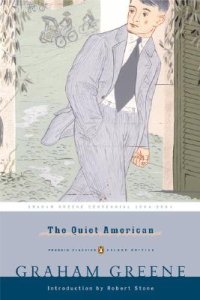
The Quiet American (Graham Greene, 1955)

An English reporter living in Viet Nam during time of fighting between French and Vietnamese (Communist) is the narrator. Mid-1950s. The narrator had pretty much "gone native," living with a local woman, regularly taking opium, etc. An American arrives as an economic attache; actually doing undercover work for a "third force" - an unreliable local warlord - in an effort to stave off the Communists. American steals girl from narrator (to his great disappointment) and saves the narrator's life when they are stranded in open country. Narrator recognizes unreliability of naive American, could be said to have a hand in the American's assassination. But he does get his woman back.

I liked this a lot. Never read anything by Graham Greene before and don't know a thing about him. The introduction to this edition of the book said he grew up in the public school tradition of service and would have believed in Britain's historic international role. I'll read more. His bio is here. The book gave one man's take on the situation in Vietnam.

I was listening to a song by Nanci Griffith, who I like a lot, at the gym this evening. She is active in Vietnam veterans' matters. (In fact, during her appearance at the Alaska Folk Festival in 2006, it was reported by one Carol Gales that she yakked about that type of thing too much and didn't sing enough.) Anyway, she mentions the name of this book and the author a couple times in one of her songs about Indochina.

Friday, November 03, 2006

We Shared the Peeled Orange ((letters from) Louis E. Braile, M.D.)


I was pretty much out of books and not able to get to the library, so went searching the shelves here in the house. And I found this book, which I didn’t even remember that we owned; it was a gift from my sister, Therese.

Dr. Braile, aka Papa, was a doctor from Minneapolis who did a volunteer tour on the Thailand-Cambodia border following the Pol Pot days. Many Cambodians (or Khmers) were fleeing Pol Pot or a subsequent Vietnamese invasion and trying to get into Thailand; many ended up in camps on the border hoping to secure permanent homes pretty much anywhere other than Cambodia. The camps were open for years, and conditions weren’t great.

Braile’s first tour was in 1981 when he was in 60s, and he kept going back (usually to the same border area); about a dozen times in total through 1996. Somewhere along the line he retired from his Minneapolis practice but kept returning to Southeast Asia. Obviously this must have been pretty challenging for his spouse etc.; one way they dealt with the separations was to write lots of letters.

Braile was traveling mostly under the auspices of an organization named the American Refugee Committee. I know just a bit about this organization, as Therese has worked there for a few years. Somebody at ARC or somewhere had the bright idea to compile all the letters into book form – and it works well. (Though they could have edited it down quite a bit and still gotten across the story.)

Anyway, the book comes across as an unusually effective way to get some sense of the day-to-day lives of folks that undertake these tasks. Braile talks about getting used to living in the Thailand-Cambodia border area: tracking down food (lots of pineapple and chicken-on-a-stick); dealing with snakes and insects; basic transportation via bicycle or crowded buses; heat and humidity; local restaurants (ice cream at Kim Kim’s); and on and on. Also day-to-day adventures in medicine: limited technology and resources; efforts to train Khmer medics; evacuation rules for leaving camp if Situation 2 or higher (shells landing in camp); rides in a hot, cramped ambulance where the Khmer passengers always seemed to be getting sick; the faith of the locals in IVs; etc.

I liked that the guy had a very positive way of describing the many, many challenges and difficulties he encountered in living situation and medical service. Also that he seemed very respectful of the local ways and didn’t automatically try to impose Western approaches, and genuinely took this as a learning opportunity for which he was grateful.

Well worth reading. And, TMG is acknowledged at page 326. ARC info is here.

Saturday, May 20, 2006

My Hitch in Hell: The Bataan Death March (Lester Tenney, 2000)

Enlisted man from Chicago is part of surrender in the Philippines. Bataan Death March, prison camps in the Philippines and Japan.

Quick read, interesting. The author - later a professor at ASU - was quite the operator - ran entertainment, gambling, prison black market, etc.

But the focus is on the awful conditions in which these POWs tried to function. The book is very good at describing this.