"To compensate a little for the treachery and weakness of my memory, so extreme that it has happened to me more than once to pick up again, as recent and unknown to me, books which I had read carefully a few years before . . . I have adopted the habit for some time now of adding at the end of each book . . . the time I finished reading it and the judgment I have derived of it as a whole, so that this may represent to me at least the sense and general idea I had conceived of the author in reading it." (Montaigne, Book II, Essay 10 (publ. 1580))

Showing posts with label Africa. Show all posts

Monday, August 03, 2026

Shifting Sands - A Human History of the Sahara (Judith Scheele, 2025)

This is a new book that sounded interesting, in part as it relates to a part of the world I've not read about much.

But I quit about exactly halfway. The storylines are interesting enough, but the incessant drumbeat of anti-West, anti-capitalist assumptions wear me out. The usual statements to the effect that slavery by Western nations is unquestionably evil, slavery in Islamic or sub-Saharan situations is nuanced. At least the author points out that there were more slaves there over a longer time period. Also from the 2025 catechism: anyone that objects to migrants going wherever they want in whatever numbers is xenophobic and/or racist.

And I don't quite know how to place what I read, mostly because I still don't know much about this area. There is far more nuance than I realized about Sahara topography, variance in oases, tribes criss-crossing; this part is interesting. (The only time I had read about anything addressing this were the WWII books discussing the campaigns in north Africa.) 

I didn't know there is a vast store of water underground - of course now there is rampant pumping and time will tell if this depletes the stores.  So far it hasn't, though localized areas have gotten dried out. 

Camels are more amazing than I realized.

As far as I got, this was an interesting follow-on to the focus on deserts in the monastic world

Friday, December 12, 2025

The Taste of Empire - How Britain's Quest for Food Shaped the Modern World (Lizzie Collingham, 2017)

(276 pages)

I had much enjoyed another one of the author's books - that earlier one focused moreso on Indian food and its evolution via British influence - so gave this one a shot.  I liked it quite a bit, though not quite sure of the takeaway. I think the main perspective was that globally-shipped, high-efficiency (in growing) food items were gaining sway a lot earlier than I would have realized.

A cool device was providing a recipe at the beginning of each chapter to anchor the development of key ingredients.

Gemini's summary:

In The Taste of Empire, Lizzie Collingham provides a comprehensive historical analysis of how the British Empire was shaped by the fundamental human need for food. Moving away from traditional political or military narratives, Collingham argues that the empire was essentially a vast global food system, driven by the necessity of feeding a growing domestic population and the commercial desire for new commodities.

The book explores the intricate "web of trade" that connected distant corners of the globe:

Commercial Expansion: It details how the pursuit of stable food sources, such as North Atlantic cod and Caribbean sugar, laid the groundwork for early colonial infrastructure.

Logistical Innovation: Collingham highlights the incredible organizational feats required to transport perishable goods across oceans, which spurred advancements in shipping, preservation, and global finance.

Cultural Exchange: The narrative shows how the British palate became "internationalized," adopting products like tea from China and spices from India, while simultaneously introducing European farming techniques and crops to the Americas and Australia.

While the book acknowledges the disruptions caused by these shifts—such as the transition from local subsistence to export-based economies—its primary focus is on the interconnectivity of the imperial era. Collingham illustrates how the modern globalized food market, characterized by the year-round availability of diverse ingredients, is the direct descendant of this historical British mercantile network.

Saturday, August 03, 2024

Retracing My Footsteps in World War II (Vernon Hohenberger)

The author had given a copy of this book to my parents some years ago; I had paged through it on St. Joe visits, and was pleased to be able to take this from the St. Joe house when we siblings "divided out" things in April 2023.

It's autographed by the author!  Vernon Hohenberger farmed near us in the Luverne/Livermore area though - since he wasn't Catholic - we didn't see him regularly - in fact, very seldom.  I have a dim recall of a very pleasant human being.

The book is fascinating. Partly because I read so few, if any, first-person accounts of the war.

Hohenberger's path overlapped geographically with that of our uncle, Irvin Bormann - North Africa and Italy. But a bit earlier in time (and later). Unlike Irvin, Hohenberger survived Italy and ended up with duty elsewhere after the fall of Rome.

He belonged to the famous 34th Infantry Division - "Red Bull" - an incredibly long combat history - at page 100 he mentions 33 months overseas. Red Bull division is prominent in all the histories of the European theater in WWII.

p. 28 - vivid memories of getting into a theater to see "White Christmas" prior to getting shipped toward N. Africa.

p. 35 - artillery experiences, here in N. Africa - reminds of Irvin's artillery descriptions.

p. 45 - his description of N. Africa "Arab" scenes - again, reminds of Irvin's.

p. 47 - he mentions the soon-to-be-famous 100th Infantry - this is the successful battalion of mostly Japanese-American soldiers mostly from Hawaii - they come up later in his story - Michener covered this in his "Hawaii" novel.

p. 50 - landing at Salerno (Irvin at Naples). I believe this was autumn 1943, prior to Irvin's arrival.

p. 53 - Volturno River - just a terrible area. Lots of detail in ensuing pages about fighting around Rapido River, Cassino. Mentions Christmas 1953.  Irvin killed in action February 1, 1944.  Monte Cassino eventually bombed February 15, 1944.

Additional discussion of finally getting furloughed and a visit home; war wrapping up by the time his overdue leave was expiring - ended up with some duty with occupation troops.

Stories of getting back into civilian life - including a short time working at a store owned by Cliff and Mary Baker (yes, Uncle Daryl's parents).

This is a quick and excellent read.

Sunday, May 12, 2024

Cutting for Stone (Abraham Verghese, 2009)

658 pages.

A good story.  Long, but well constructed.  All the pieces fit, including application of medical specialty.

Ghosh as a perfect person. Also Sister Mary Praise. And Matron.

Hema (and others) bringing across many things we saw in India (rangoli, mask, food).

Genet kind of an annoying character; her mother not stable.

Some idea of what it might have felt like to move from India to Aden and then to Ethiopia.

Gave a reader like me some feel of the uncertainty in unstable government situations (I of course have not had to deal with this).  We grew up familiar with Selassie, Mengistu.  And heard of Eritrea. Author speaks to Italian influence here - more than I would have expected.

I found especially striking the part where Marion lands in NYC for the first time.  The sensations of a new world - one could kind of imagine how this might feel. This was a favorite section. (Reminded me, though in the smallest way possible, of returning to that same airport in June 1975 after three weeks in Europe, though my surprise was mostly seeing (being reminded of) the hugeness of American automobiles and the width of American roads.)

Roman Catholic nuns had so many highly valuable, unselfish roles for a few centuries there.  Kind of sorry that went out of fashion.

Matron's idea of "Nurse Sense" - that made sense to me.  Applies in other professions as well.

Monday, June 20, 2022

The Writing of the Gods - The Race to Decode the Rosetta Stone (Edward Dolnick, 2021)

I had previously read a lot about Napoleon (and his "savants") in Egypt but this still was a useful take.  The understandable ensuing craze for things Egyptian.  (Reading "The Ambassadors" by Henry James right now - protagonist visits a house with a history, including items from Napoleonic era - including a sphinx figurine, of course.)

Thomas Young and Jean-Francois Champollion are the key workers on the project.  It was really difficult!

Reiterated some ideas that appeared in this book (about deciphering Linear B) in an interesting way - this author made more of an effort to explain the decipherer's challenges in terms of challenges encountered in dealing with the English language - helpful.

A good way of describing the incredible importance of writing in human development (if it started rather humbly largely to record transactions) - can speak across distance and time!  Things can be remembered in large measure.

The idea of speaking as something babies learn - long evolutionary history - writing came along so much later, no one learns it without being taught.

The art of deciphering - discussed the skillset in similar terms as the fellows that made the breakthrough contributing to US success in Battle of Midway (per here) - some folks have gut instinct to go along with knowledge of languages, ability to comprehend and retain complex visual fields - seems like you can't get there without educated guesses; and that successful decipherers may not even be able to fully explain how they do it.

Monday, February 21, 2022

Africa - A Biography of the Continent (John Reader, 1997)

(682 pages)

Kind of a strange book - all related to Africa, but bounces around so much (and covering this much territory in one book is of course impossible).  But I much like, enough to do a pretty careful re-read (first read, in 2003, back here).

Maybe too much emphasis on justifying why Africa's population growth and overall development has been slow in comparison to the places where African migrants settled; that it's not due to inferior skills and initiative.  Though I suppose so many non-African experts - and common folk -  over the centuries have drawn that conclusion, that he feels a need to rebut?

Explains why most of Africa was and is generally a challenging place to live - low population densities; growth after periods of "good" years leads to trouble when normal (drier) conditions return.  Conflict, but not large-scale wars (except Egypt).  Lack the manpower; also tended not to own stuff that could be accumulated and fought over.  Seldom enough labor available - a continuing problem.  Unique challenges like the tsetse fly.

A good review of the Portuguese explorers - their rather impressive accomplishments mapping the coast in 15th century and beyond.  Others elbow them out of the picture by end of 16th century.

Influences from abroad not benign - as technologies were developed locally and (more often) brought in from elsewhere, perhaps some sort of sustainable local economic and political systems might have evolved without so much interference.  Seems to lament this quite a bit - but kind of pointless - Africa not the only place where less developed societies get flattened, reshaped by more developed aggressive neighbors.

Though it is so sad in Africa.  Arab slavers bad enough.  Then the system is amped up with the Europeans and the Americas, while the Arabs continue.  Prime labor - always in short supply - is shipped away in exchange for pointless prestige goods, guns, horses that flow to the elite - no motivation to develop local economy and less folks to accomplish it anyway.  (Some of that sounds like more recent foreign aid programs - elite siphon off the goodies; donated goods (especially food) choke off development of sustainable local capacity to supply the same.)

Discussion of how the slave trade affected so much of the continent - even areas far from the coast.  Plenty of complicit locals, but the scale was not driven by locals.

Interesting discussion of South Africa; the Boers; finding diamonds (and gold); solving labor shortages by rather awful methods.

Then the rather amazing late 19th century "scramble", the Congo (again solving labor problems by awful methods), the carving up of states on lines that didn't reflect the locals.

And yet - lots of growth, lots of room for optimism.

Not quite sure how it all fit together, but the book started with lengthy discussions of geologic history and evolution, lots on hominids to humans.  This part was actually quite thought-provoking.  Walking upright; chewing; talking; developing a large brain, taming fire, developing agriculture, on and on - that's a lot to happen!

Interesting idea - that colonial administrators trying to rationalize things post-WWI came on the scene after a devastating cattle plague (rinderpest) and famine - they thought depopulated areas had always been that way - some of the game preserves formerly had human populations, now we think the "natural" state is animals-only.

Friday, October 18, 2019

Arabs: A 3000 Year History (Tim Mackintosh Smith, 2019)

(536 pages)

I found this consistently interesting and useful - recommended. A motivation for reading is my confusion about the term "Arab" - so few of them it seems, yet widespread use of the term around the Middle East and Northern Africa, etc.

Notes follow -

opening segment explores period before Islam - seldom read about this - points out, that as one might expect, Islam didn't arise out of nowhere.  ideas attributed to Mohammed had roots

pilgrimage to a town mentioned cb Mecca precursor

settled areas in the south - current Yemen - including Saba (OT refers to as Sheba, as in "Queen of").  north interacting with Fertile Crescent.  wanderers in the center - nomads, raiders - referred to as a'rab, though origin unclear.  greener at one time, though that's so long ago.

as mentioned in this book - superpowers would use/abuse these folks (Babylonia, Assyria; Rome, Persia) in their own contests - became important power brokers over time - unique ability to travel and raid in unfriendly terrain. as superpowers exhaust each other, opportunity arises; combination of camels and horses - lethal!

organizing thesis for the book is the language - I think meaning "high Arabic" - not really spoken, but widely understood - Koran as highest expression

deciding to administer lands in Arabic probably saved the language, rescued it from fate of Latin/Greek, overcame thinness on the ground of actual Arabs

conquest and language spread first . . . then Islamization - hard to define it - Tom Holland discussion, this is a couple hundred years after the fact and with specific political and social needs to address.

Arabs from "the island" (saudi arabia proper) are few in number and swamped by locals in many or most places conquered during the outburst.  prime example = Persia - culture and numerosity overwhelmed - even in terms of Mohammed's [sons?] marrying Persian women

deep divisions from the very beginning

reactionary forces strong, seemingly significantly stronger than in other cultures - the idea that everything stopped with the Koran [and whatever approved interpretations] - rather amazing lack of progress that persists to this day

oddity of contemporary Egypt as an Arab state in many respects (other states in the area as well) - Arab, really?

complicated to say the least

Tuesday, February 27, 2018

The White Nile (Alan Moorehead, 1983)

(307 pages)

The author makes all this come to life - I enjoyed this every bit as much as my initial read about 20 years ago. 

The book focuses on events along the upper Nile in the mid-19th century.  Many famous names are involved here, starting with Burton and Speke.  Later comes David Livingstone (biography here), Henry Morton Stanley (biography here), Samuel and Elizabeth Baker (story here), Charles Gordon (and the fall of Khartoum to the Mahdi); even Herbert Kitchener and Winston Churchill show up toward the end of the story (Omdurman, etc.)

Amazing that the interior of Africa remain largely unmapped well into the 19th century.  The search for the source of the Nile dated back to Herodotus and beyond.  These Victorian explorers finally solved the puzzle.

East-central Africa grievously affected by Arab slave traders in these days; at this time slavery was being outlawed in Britain and, eventually, the US; but the slave trade had a big impact upon the explorers. Sad stories of the Zanzibar slave markets.

Some effort to convert the natives to Christianity, but the main players seem much more driven by the urge to explore.

An interesting angle:  indirectly this is a story about Britain in the middle of the 19th century - at the peak of its powers - as in India (per discussions here) and elsewhere, not necessarily strategic or even intentional in where it ended up - but high-impact wherever it went in those days.  Many who spent years in foreign outposts ended up unable to stay away.

Britain's influence, or interference, of course not necessarily benign for the natives.

I really like this book, and stories about this topic in general.

Friday, January 27, 2017

The Thing Around Your Neck (Chimamanda Ngozi Adichie, 2009)

Book club selection (via Rose; session held January 22, 2017).

Typically I avoid short stories.  And contemporary authors.  Would have been a mistake to miss this collection, however.  And perhaps I need to revisit my book selection guidelines?

Author communicates things like:  (1) challenges of the immigrant - seemingly mundane things like English usage, grocery store navigation; larger things like attitudes of locals; (2) challenges of the newly-emigrated in dealing with those-who-emigrated-just-a-few-years-earlier; (3) challenges of being female in situations where males are favored - without being preachy or annoying about it; (4) the disorder and perhaps charm of a place like Nigeria.

My favorite stories:

--story #3 - two women in a store during a riot

--story #4 - retired university professor runs into someone he thought had be3n killed in the war following Biafran independence

--story #10 - aunt/uncle arrange their niece's marriage to an American doctor (previously had emigrated from Nigeria) - she meets the doctor - not in love but sticks it out - interesting stuff about transitioning to America

--story #12 - only story set earlier in time - arrival of white men, protagonist's son becomes one of them, next generation rediscovers earlier culture - well written

Thought-provoking throughout, good.

Wednesday, May 18, 2016

Wildflower - An Extraordinary Life and Untimely Death in Africa (Mark Seal, 2009)

Book club selection (via Emily; session held May 15, 2016).

The main story line revolved around a star-crossed, I'd say, couple - both living in Africa and connected to the Kenyan community.  Married in 1961.  Alan Root as the outgoing, charismatic, innovative nature film maker; Joan Root as his do-everything self-effacing back-up.  The author never tires of describing how talented and beautiful she was.  The couple buy a house on Lake Naivasha - which we learn is very scenic - and later under threat from development and poaching.  Successful film-making continues.  Then Alan meets Jennie, and the relationship part - which always seemed frayed - broke.

The Roots were pioneers - maybe too strong of a word, but not much if it is - in nature films.  Interesting to read how they went about it; major success on BBC; they somewhat created the genre that we now take for granted.  Alan the creative force.  They met up - and in some cases advised/mentored - folks that became household names - Leakey family members, Diane Fossey, Joy Adamson.  British royalty.

As the years go by things change drastically in Africa - population pressure; rose-growers crowd the lake; huge market for poachers (China?); Joan, perhaps needing a cause post-Alan, gets heavily involved in her view of conserving the lake area.  Some iffy fellow named Chege is her lead enforcer.  As the book title conveys, she ends up getting offed - no clear reason - though she wasn't particularly young anymore.


Friday, November 14, 2014

An Army at Dawn - the War in North Africa,1942-1943 (Rick Atkinson, 2002)

This is the first volume in Rick Atkinson's quite excellent trilogy covering US role in World War II.  For whatever reason, I read it last among the three books (volume two discussed here; volume three discussed here).  Would have been useful to have read the three works in the correct order - mostly to gather the background on key personalities plus understand how some of the initial maneuverings related to later efforts - but each of the three works also stands quite nicely on its own.  All highly recommended.

I had read a bit about the US efforts in North Africa as part of larger histories; also did some reading about the British experience there (for example, this book).  But very much ignorant for the most part.  So this was quite valuable.

A few ideas:

1.  The incredible amount of preparation required for the US military to participate effectively.  The lack of sophistication resulting in severe setbacks.  Reminiscent of WWI.  (And I don't have the slightest criticism of this - seems quite fine that the country didn't maintain a large standing military presence in the run-up to either of the world wars.)

2.  I need to better understand Hitler's thinking in relation to the Vichy regime.

3.  Such an awkward situation with the French military in North Africa - protecting this territory against the Allies was part of the Vichy government's deal with Hitler.  Weird that in the early going the Allies fought battles (sometimes pitched, sometimes desultory) with the French in North Africa!  While trying to work with the "Free French."  Casablanca-style intrigues.

4.  Rommel, Kesselring.  Manpower and materiel shortages plaguing German army (along with Italian ineffectiveness).  German troubles in Stalingrad and Kursk; Italy wavering; Hitler limited in ability to allocate resources to North Africa even while pulling some divisions away from Russia.

5.  The Allied politicians - Roosevelt and Churchill primarily. England pushing to prioritize the Mediterranean operation.  Eisenhower's maturation in an incredibly challenging job.  Titching between British and US military folk at all levels.

6. Difficulties with ambitious amphibious landings - large, but significantly smaller scale than would be undertaken in Italy and Normandy.

7.  Kasserine Pass.

8.  Quite a bit of focus on a division (34th) with heavy representation from Southwest Iowa (including a leader from Red Oak).

9.  The story of Count Stauffenberg's injuries in North Africa at the hands of strafing fighters; he uses his recuperation period to work on the assassination plot involving the briefcase under the conference room table (recounted in the recent Tom Cruise movie (Valkyrie)).

10.  The goums and their penchant for collecting Nazi ears for bounties (fake submissions suspected, however).  I need to re-read Irvin Bormann's diary on this topic.

11.  As in the other two volumes:  plenty of references and connections to wars fought in these areas going back to classical times.  (In this case:  a focus on Carthage.)

12.  Patton was pulled away from the final stages to focus on plans for invading Sicily (leading into volume two).

Borrowed from PJr.


Friday, December 20, 2013

A Season in Hell - My 130 Days in the Sahara with Al Qaeda (Robert Fowler, 2011)

K picked this as selection #2 for the little book club that we (mostly NOC as driver) are initiating.  Will update this post with a few thoughts sometime after the big BC session.


Friday, July 26, 2013

Between Man and Beast - An Unlikely Explorer, The Evolution Debates, and the African Adventure that Took the Victorian World by Storm (Monte Reel, 2013)


Easy read, not terribly enlightening.  Biographical regarding Paul du Chaillu - something of an outsider with West African/French roots, then spent some time in the U.S.  Got the idea of forming an expedition into west Africa - his old stomping grounds in Gabon - with primary purpose (if undisclosed) of bringing back gorilla skins.  Gorilla largely unknown at this time - 1856 - (author says du Chaillu encountered "lowland" gorillas; the "mountain" gorillas of Diane Fossey fame weren't known to whites until around 1900).

His timing overlapped precisely with the finalization and publication of  Darwin's "Origin of Species" and accompanying debates.  He was an amateur explorer - though apparently brave and effective - with a gift for recounting tales.  And tales about gorillas couldn't have fit better with the debates about evolution, man compared to apes, etc.  He was accepted and sponsored by some of the big names in the Royal Geographical Society (England) - panned by plenty of others.

The "Gorilla Quadrille" - oh wow.

One of my main reasons for reading this is a desire to get a better handle on Victorian England - it had some value in this regard.  For example, it explained Charles Mudie's lending library and its effect on novelists - even the big names modified their approach to fit his demands.

I've read plenty of other books about African exploration that were more interesting, however.  Not particularly recommended.

Monday, March 11, 2013

The Catastrophist (Ronan Bennett, 1998)


[Re-read for book club (per CPG) in 2014; below discussion is from original read in 2013.]

Something very different for me:  a modern novel.  Nothing really wrong with this book, though it reinforces my decision to focus on catching up with works that have stood the test of time.

Writer from Northern Ireland (Seamus n/k/a James) is in love with Italian communist (Ines) resident in the Congo at the time of independence from Belgium; he joins her there.  She sort of loves him but ultimately is more interested in causes than anything else - supporting Patrice Lumamba.  There is a CIA-type character working connections - opposed to Lumamba due to his leanings toward Communism.  Also various Belgian folks.

Generated some interesting thoughts about the transition to independence and the dire situation in these countries.  Somewhat useful followup to discussions in book like this about the way King Leopold abused the Congo.

Monday, September 05, 2011

The Fate of Africa (Martin Meredith, 2005)

I blew through this pretty quickly.  It was interesting - just intensely repetitive in terms of outcome.  The awful stories across Africa since the days of independence vary greatly by country, don't seem to vary much in terms of moving backwards.

The author pretty much just recounted the stories.  I was hoping for more analysis or explanation, and maybe even a little reason to hope that things might be getting better.  But no.  I guess it's useful to absorb some of the factual background as a starting point.

The author reports that most African countries have a lower per capita  income than in 1980 and, in some cases in 1960.

Aid workers, government workers, government cronies are the only folks that generate steady income or wealth.

This made me think about a few things:

1.  My sense is that the "bourgeois virtues" - as discussed so interestingly in this book - are almost entirely absent in Africa.  I don't know much about Africa but would guess that there wasn't a reason to develop them.  Absent the bourgeois virtues - how is wealth going to be generated there?

2.  Governments ran things in Africa - private sector basically absent.  For the most part, funds and resources have been allocated for personal and political purposes much moreso than for sound business or economic purposes.

3.  The United States and plenty of other countries are currently debating how many (more) $$ to turn over to governments - do we continue the trajectory?  Resources run through governments inevitably are allocated through politics and access.  We can talk all day about how different our situation is from Africa's, and capitalism's imperfect allocations.  But still.

There are so many awful African occurrences noted in this book.  To list a few:  Ethiopia/Mengistu/Biafra/famine. Rwanda/Burundi.  Somalia.  AIDs.  Mobutu.  Mugabe.  Sudanese civil war.  Islamist parties.  South Africa. Rhodesia.  One-party states.  Big Men rule.  Corruption, diversion of aid.  Angola.  I had forgotten how Cold War politics led to Cuba, USSR and US, among others, intervening in pointless episodes.  Ugh.  

Monday, November 30, 2009

Stanley - The Impossible Life of Africa's Greatest Explorer (Tim Jeal, 2007)

I had read Jeal's biography of David Livingstone (summarized here), so was quite interested in reading this biography. And was surprised to find it even more enjoyable. The subtitle ("Impossible Life of Africa's Greatest Explorer") sounds quite hyped but ends up seeming to be pretty accurate on both counts.

Stanley was Welsh; pretty much abandoned by family; spent years in a workhouse; took a chance on working a ship to the United States; spent some time in New Orleans; somehow got involved in the Civil War (fought at Shiloh); deserted; ended up in the Navy somehow; on and on. One point of comparison to Livingston - Stanley also had a background from which almost no one emerged into prominence. The author contends this led to insecurities which accounted for behaviors which harmed Stanley's reputation (sounds simplistic but makes some sense when it's all laid out).

Ended up as a newspaperman in the midwest, then took the job with the New York Herald; had developed the idea of an expedition to "find" Livingstone - though often there was doubt that he was "lost." Somehow obtained funding and succeeded - with very limited background for this kind of thing - and struck up a close relationship with Livingstone. Supposedly he never said "Dr. Livingstone, I presume" - the author think he put this in his journals/letters because he thought it sounded "right."

Not very popular in England despite his achievements - in part because they thought he was American, and certainly he wasn't of the correct class. Wanted back in Africa, best available route was working with King Leopold of Belgium. Leopold fooled pretty much everyone, but Stanley was tarred with responsibility for the atrocities in connection with rubber gathering, etc. He was competing with French explorers, though this was prior to the "Scramble."

He made one final unbelievable journey in support of Emin Pasha. Who also wasn't sure he wanted any help.

He married late in life; sounds like this worked out ok, though his wife wouldn't let him return to Africa and he didn't care for hanging around in England. They eventually adopted a boy.

Saturday, July 18, 2009

To the Heart of the Nile - Lady Florence Baker and the Exploration of Central Africa (Pat Shipman, 2004)

I am always fascinated reading about African exploration (most recently, this one). This book was also very interesting. But not that great. It felt like it was written for a junior high class where the teacher was interested in touting the "woman's perspective." I wouldn't chase down any more of her books.

The story line is another one of these unbelievable situations. 38-year-old widower (stalwart Englander) traveling in eastern Europe (Ottoman territory, I think) spontaneously bids on a 14-year-old Transylvanian girl being presented at a Turkish slave auction as a high-priced virgin (harem product) who could speak a European language. He had never seen the girl before. Outbid by the local headman. So he did the only logical thing: abduct her (before ever having spoken to her) and head for the border.

So of course they fall madly in love. Samuel Baker is an adventurer and shortly thereafter takes up the idea of searching for the source of the Nile (inspired by similar efforts of Burton, Speke, etc.) His new wife (Florence, as Anglicized) tags along on all of his trips, facing the usual litany of awfulness that those trips involved. High risk for anyone, super high risk for a woman.

It is pretty amazing.

They didn't find the source - Speke gets credit - but they did quite a bit of useful geographic work and came back to England as heroes. They were so popular that Florence's past - a non-starter in Victorian society no matter how much it wasn't her fault - was generally overlooked.

A few thoughts:

1. Florence had ended up a slave as part of the unrest in the 1848 revolution where Louis Kossuth sought to gain a measure of independence from Austria for Hungary. Kossuth was viewed in America as some sort of patriot and freedom lover, thus there are places named for him. Like the Iowa county in which I was born (and which was laid out shortly after 1848).

2. Samuel & Florence were mightily frustrated trying to get the natives to function in anything near the manner that folks back in Europe would have functioned. Much commentary that definitely wasn't PC.

3. Allowing for that - unfortunately it all sounds too familiar in many key aspects going back to these very early European incursions into Africa. Western powers in it for a mixture of trade and territorial ambition and to reform the benighted natives (including I think some sincere motives). Main method of dealing with the locals seems to be to endlessly provide gifts (then: trade beads and weapons to the leaders, now: cash (outright aid, or loans that won't be repaid) and weapons) to the leaders. The leaders typically kept, and keep, the lion's share of the gifts with pretty much zero benefit to the society as a whole. Ugh.

4. This book was helpful in sorting out the Ottoman empire relationship with Egypt. Nominally it was part of the Ottoman empire, but Egypt took counsel with England before doing much of anything. Which is how folks like "Chinese" Gordon ended up as a pasha in Khartoum when the Mahdi overran the place (Baker also was a pasha on the Egyptian payroll for a few years.)

Saturday, July 12, 2008

Livingstone (Tim Jeal, 1973)

Livingstone is another one of those folks whose story - if presented by a writer of fiction - would be considered too unrealistic to have much merit.

Not much point in recounting details of his life here, but I would recommend reading the basic information via this link.

I was particularly struck by the odds that the guy overcame to gain an education. His father worked in the mills, and Livingstone worked there as a child - 6a to 8p. The entire family (mom, dad, five children) lived in a 14 x 10 foot room with two bed recesses. And he taught himself enough Latin, botany, theology and math to get into medical school by the age of 23.

Livingstone eventually figured out that missionary work in China was a ticket out; he had an urge to explore early on. Ended up in South Africa (the first Opium War broke out and cut off China opportunities) under the thumb of a domineering older missionary. Eventually focused far more on exploring than on being a missionary, though his PR back home depended on emphasizing the missionary work. Later switched to anti-slavery rather than missionary as a cover for his explorations. Spent lots of time looking for the source of the Nile but ended up on the wrong track. It appears that he was willing to be less than forthright about risk of disease and local conflict, ending up bringing folks over to Africa that were not prepared for conditions and there were plenty of casualties.

The toughness that permitted him to escape the mills turned him into a pretty heartless, insensitive type; he functioned far better with native workers than with Europeans. Unbelievable ability to travel under impossible conditions, fight off malaria, etc.

I never get tired of reading materials on the 19th century explorers of Africa - the ultimate intersection of completely different cultures.

Later on of course was the famous meeting with Henry Stanley: "Dr. Livingstone, I presume?" Followed by his death in Africa, and the unbelievable return of his body to England. Project Gutenberg has an e-book of his last journals which is located here - this is very much worth perusing if you want a sense of what he was going through.

Incredible popularity in England and beyond, well explained in the article linked above.

The map shows his wanderings; some in search of the Nile, others for waterways that would bring commerce into the interior. Amazing that they were still unable to find the Nile source well into the second half of the 19th century.

Jeal writes well and has just published a new work on Stanley, which is on the list.

Friday, February 02, 2007

The Last King of Scotland

Patricia and I went to this movie at Camelview in Scottsdale. We went mostly because the guy playing Idi Amin (Forest Whitaker) had received so much favorable attention for his role. He definitely did a very fine job, though much of the time the Amin character was cartoonish.

The story revolved around a fictional Scottish doctor who went to Africa to do good and have some fun, and ended up as Amin's personal physician and overall confidante. The movie placed the action around various events in Uganda during Amin's day, including the Entebbe airport situation.

Name of movie was derived from a supposed affinity of Amin for all things Scottish, stemming from his early military days in the British colonial military. More on Amin here.

Good but not great.

Monday, September 25, 2006

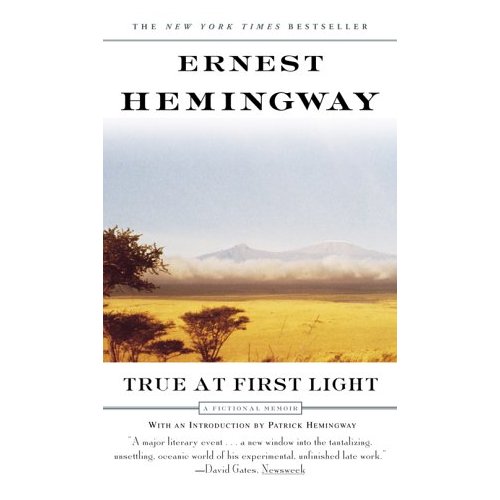
True at First Light (Ernest Hemingway, 1999 (posthumous))


Starting back in August 2005, I've gotten through For Whom the Bell Tolls, The Sun Also Rises and A Farewell to Arms. And I was ready for a break from Hemingway, but this book looked to be something different.

And it was. His son (Patrick) actually edited this for publication 35 years after Hemingway's death. It is based on experiences on safari near Nairobi in 1953. I think the manuscripts (which were extricated along with other unpublished stuff from Cuba in exchange for Hemingway's real estate) needed a lot of work, and the book is uneven. But I ended up really liking it. The book is pretty much autobiographical, though fictional. It being 1953, the old-style safari and colonial days are done for. The protagonist oscillates between his American and European mores and the African lifestyle that he seems to really enjoy. His wife kills a huge lion, using her mediocre hunting skills. He likes a native girl. They hunt and drink and talk and fly in airplanes. It's good.

Hemingway had quite the interesting life, summarized here. Injured while driving an ambulance in Italy during WW I (A Farewell to Arms gets into this). Hung out in Paris in some expatriate group after the war (The Sun Also Rises gets into this). Spent time in Spain around the time of the Civil War (For Whom the Bell Tolls gets into this). And all sorts of other things before shooting himself in the head. Of those three novels, I thought For Whom the Bell Tolls was definitely the best.

Also read this at the gym. (It's amazing how many pages you can cover during 30 minutes every other day on a stairmaster.)