(427 pages)
story takes place mid-19th century into mid 1920s
set primarily in Lodz; the town springs up from something of a village; much heavier Jewish concentration than most places; commercial and manufacturing center for textiles
Poland then part of Russia; Lodz merchants doing business throughout Russia; growth and change
twin Ashkenazi brothers - more detailed focus on Max - feverishly working to be #1 in the local industry (textiles); Jacob less talented, less intelligent, less diligent - but natural personality and physical gifts and unnaturally good luck
two other primary characters - Nissan and Tevye "The World Is Not Lawless" - work in local factories and seek to organize them; socialist speeches, Marxist dogma that would have sounded right at home in '20 presidential campaigns (complete with deeply religious strands)
all four leading characters working hard for entirely different things but in parallel ways and with similar results
all four leading characters from deeply Jewish backgrounds; changing but some retention
lots of character development including families of the four; earlier generation deeply traditional from the countryside/shtetl (typically relatively new to Lodz, it being a new town); Hasidic; rabbis with vast authority; this changes over time
some - certainly the Ashkenazi brothers - seek assimilation; not accepted but keep trying; as shocks such as economic downturn, war, inflation hit - guess who gets blamed
boom years in Lodz; then 1905 war with Japan; WWI; German occupation (shut down businesses, strip assets and ship west); Poles reassert themselves after Versailles treaty; part of the plot moves to Russia (during the 1917 revolution and thereafter - business couldn't be conducted during German occupation)
throughout - Jews tolerated to a point especially when useful, otherwise look out;
strand about considering Palestine
Buddenbrooks comparison, which makes sense
no way to assess accuracy - but much liked that Singer painted this detailed picture of what that world must have been like - the level of detail indicates he knew all about it
recommended - there's a lot going on here
Too often I read a book, and then quickly forget most of it (or all of it, for less memorable works). I'm hoping this site helps me remember at least something of what I read. (Blog commenced July 2006. Earlier posts are taken from book notes.) (Very occasional notes about movies or concerts may also appear here from time to time.)
"To compensate a little for the treachery and weakness of my memory, so extreme that it has happened to me more than once to pick up again, as recent and unknown to me, books which I had read carefully a few years before . . . I have adopted the habit for some time now of adding at the end of each book . . . the time I finished reading it and the judgment I have derived of it as a whole, so that this may represent to me at least the sense and general idea I had conceived of the author in reading it." (Montaigne, Book II, Essay 10 (publ. 1580))
Showing posts with label Poland. Show all posts
Wednesday, February 26, 2020
Sunday, July 10, 2016
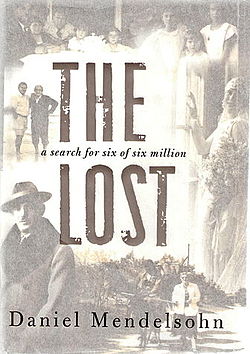
The Lost - A Search for Six of Six Million (Daniel Mendelsohn, 2006)
Wasn't really looking for *another* Holocaust book. But PJ was recommending this pretty strongly, so I thought I'd be a good sport and take it up.
Very glad that I did - some perspectives that I found quite unique.
The author is a professional writer - NY Review of Books, NYT magazine, that sort of thing - and became deeply interested in history even as a child, he thinks due to influence of his grandfather. Family origins in Bolechow, Poland; many emigrate as things get tough; six stay behind and disappear as Germany takes over following Hitler turning on Stalin in 1941. Limited and not always consistent information is available about how the six were liquidated, but author decides to search for more.
Travels to Bolechow; then Australia, Israel, Scandinavia. Reconnects (or connects) with photographer brother who seems to do very nice work (wish the photos had been given more prominence in the book).
Author uses a meandering storytelling style - takes some patience - 503 pages - but well worth it. Interactions with survivors; some pretty amazing coincidences enable information to be discovered; very powerful as author descends into the kestl.
Particularly useful to me - he pulls together threads I'm pursuing - family history research; weaves Old Testament stories (particularly Cain & Abel, Noah, Abraham), along with interpretations from two Torah commentators, into his narrative; Jewish history in eastern Europe; stories of the Polish borderlands (Galicia), last flickering remnants of the old Habsburg days; plenty of tension among Poles, Ukrainians and Jews but at least they could live together and function for the most part (other than the occasional outbursts, which were awful enough). Jews now all gone.
The awful episodes during the several Aktions, including at Dom Katolick. Hidden in a teacher's house. Polish boy makes the mistake(?) of falling for a Jewish girl. Uncle Shmiel loses his permit to run his truck. Stuff that happened with Jews under 1930s German diktats (with plenty of local collaboration) - wow. Ukrainians take advantage.
Searching for the personal detail that prevents - ok, only delays - a person (pretty much every person, ultimately) from being entirely, utterly forgotten. Searching for how it might have felt (not just how it happened).
Author states that his grandfather was renowned for his storytelling ability, and he tries to describe his grandfather's method; then describes his dilemma about how to shape the story he is learning about in his researches . . . of course he's signalling that he will be using his grandfather's method to tell this tale. Which he does, very effectively.
Tuesday, December 15, 2015
Poland - A History (Adam Zamoyski, 2009)
I find this author quite readable (here, and here). Motive for reading this book - I know so little about Poland, yet it appears my wife has about 3/4 of her heritage there (meaning 3/8 for our kids) - that's a lot.
Zamoyski comes from a family with a long history in Polish nobility.
So what did I learn? Way too much to keep straight, but some useful strands:
1. Poland had very large land territories at various stages in what I'll call early-modern times. Arrangements with Lithuania, Ruthenia (Ukraine), etc. Often lightly populated and loosely controlled - but a large power player.
2. Russia got stronger. German states got stronger, culminating in 19th century unification. But even somewhat before that - an essential issue for Poland is its unfortunate position between Russia and Germany. A huge effect on its history especially in early 18th century and after.
3. Hard to believe that Poland was simply partitioned off the map following a sequence of moves primarily involving Germany, Austria, Russia. Polish politics wrapped up in regaining the homeland; less experience addressing practical governance.
4. And of course there was the Soviet era.
5. Farther back - a governing method that involved an elective king and required lots of consensus - in some ways probably quite modern - but in the end this paralyzed the state.
6. As I've gotten to understand better - in part because of the Zamoyski books linked above - the concept of the "nation" and "patriotism" are incredibly slippery, and dangerous. So much is invented after the fact for reasons of state. There does seem to be a core . . . but on the margins, what really is "Poland" and "Polish?" Borders and peoples have moved around for as far back as our knowledge extends.
7. A consequence of being positioned so far east - Cossacks, Tatars, Turks. Important roles in fighting the Ottomans.
8. And the incredibly large Jewish population - at least compared to other European countries - lightly-populated areas welcomed Jews getting kicked out of western European countries. Though once in place - often mistreated.
9. Roman Catholicism certainly not a sure thing! Look at the geography.
10. Lots of diplomatic noise in 19th and 20th century about re-forming a nation of Poland - but mostly talk, as the balance of power seemed to work - and radical change like this could upset things. Short-lived state post WWI.
Zamoyski comes from a family with a long history in Polish nobility.So what did I learn? Way too much to keep straight, but some useful strands:
1. Poland had very large land territories at various stages in what I'll call early-modern times. Arrangements with Lithuania, Ruthenia (Ukraine), etc. Often lightly populated and loosely controlled - but a large power player.
2. Russia got stronger. German states got stronger, culminating in 19th century unification. But even somewhat before that - an essential issue for Poland is its unfortunate position between Russia and Germany. A huge effect on its history especially in early 18th century and after.
3. Hard to believe that Poland was simply partitioned off the map following a sequence of moves primarily involving Germany, Austria, Russia. Polish politics wrapped up in regaining the homeland; less experience addressing practical governance.
4. And of course there was the Soviet era.
5. Farther back - a governing method that involved an elective king and required lots of consensus - in some ways probably quite modern - but in the end this paralyzed the state.
6. As I've gotten to understand better - in part because of the Zamoyski books linked above - the concept of the "nation" and "patriotism" are incredibly slippery, and dangerous. So much is invented after the fact for reasons of state. There does seem to be a core . . . but on the margins, what really is "Poland" and "Polish?" Borders and peoples have moved around for as far back as our knowledge extends.
7. A consequence of being positioned so far east - Cossacks, Tatars, Turks. Important roles in fighting the Ottomans.
8. And the incredibly large Jewish population - at least compared to other European countries - lightly-populated areas welcomed Jews getting kicked out of western European countries. Though once in place - often mistreated.
9. Roman Catholicism certainly not a sure thing! Look at the geography.
10. Lots of diplomatic noise in 19th and 20th century about re-forming a nation of Poland - but mostly talk, as the balance of power seemed to work - and radical change like this could upset things. Short-lived state post WWI.
Tuesday, July 15, 2014
The Pianist (Wladyslaw Szpilman, 1945 (translation 1999))
Book club selection (via PJ).
Hadn't realized the quite-fine movie of the same name was based upon a book by the protagonist. And it's interesting that - for once - the movie pretty much tracked the book.
Szpilman was a pianist for Polish Radio in the run-up to World War II; he was playing a Chopin Nocturne on the air when the Germans knocked out the station. There followed the awful times for Warsaw Jewry (Polish situation described here, for example). Establishment of Warsaw Ghetto; systematic reduction of the population; random violence; overcrowded conditions leading to illness, starvation, misery. He recounts the scene in the train yard (also in the movie) where his father purchased a black market overpriced chocolate and cut it into six tiny pieces - the last family meal.
Very spare writing style, which I think was also very effective. Hard to believe the author - with all the challenges simply to survive - was able to put this together in 1945. It generally was suppressed for decades thereafter.
The friendly German is an interesting character - very helpful to have his diary extracts at the back of the book (also the epilogue). Some discussion whether the diary extracts were somehow written after the fact, but I rather doubt it. Still, would have been mighty dangerous for the diarist if his musings had fallen into the wrong hands.
Another reminder of the sorry opportunism of local populations - often crueler to the Jews than the Germans were (which is saying a lot). The incredible risks taken by those willing to assist Jews.
Szpilman played the same Nocturne as the first broadcast on Polish Radio following expulsion of the Nazis. Pretty amazing story.
Thursday, January 26, 2012
The Emperor of Lies (Steve Sem-Sandberg, 2011)
This book is very unusual, and (I think) very valuable. Over the course of 600+ pages, it made me really uncomfortable quite regularly. Presumably that was one of the author's goals.
As to Holocaust literature - I'm slowly getting a little more perspective on this. Reading this book helped me understand that for many years following WWII, the focus was kept only on the nations (as a whole) that were victimized by the Nazis - very little attention was allowed to the idea that the Jews were a special target - instead, they were lumped in with the rest of the population. This changed in the 1960s - one catalyst was the 1962 Eichmann trial - one of the first times the special (mis)treatment of Jews was highlighted. Over time following this, things changed. The camps became memorials, the politicians starting apologizing, movies were made, books were written, museums pop up all over the world. One profane comic in 2012 is saying, among other things, that "the Holocaust of course must not be forgotten, but that doesn't mean we are required to talk about it 24/7."
So is there too much attention, and am I personally reading too much about this? Who knows - the circumstances are way beyond compelling. That makes for great story lines, but also makes them perhaps less applicable to the more normal circumstances we customarily face.
This book is a novel, but based on an unusual place - the Polish city of Lodz (just a bit southwest of Warsaw) - with what became the second-largest ghetto. Something unusual is that the Jewish administration maintained The Ghetto Chronicle - and may other written records survived. So the novelist can piece together a story of life in Lodz during the many years (February 1940 through the end of 1944) under Nazi domination. And include characters as to whom there was a wealth of information.
View Larger Map
And it's thoroughly, thoroughly depressing. The "Emperor" is a Jewish businessman who became an authoritarian figure over the ghetto (though always under the thumb of the local Nazi administration). The "Emperor" believed that cooperating with the Nazis was the key to survival - primarily through everyone working hard at factories. He talked like a politician. Collaboration. Jewish-operated factories making parts for the Luftwaffe, uniforms for the Wehrmacht. How strange it must have been! But survival comes first.
Power corrupted even in this odd little world - the Emperor could indulge his unsavory habits and patronize his family, friends and favorites; payola and bribes for many in power while incredible tales of heroism by others. The litany of awful decisions in ghetto circumstances - how much food, who gets deported, what to do with those that can't work. Struggling to keep jobs and avoid getting transported, while always cold and hungry. Clandestine radios. Terrible scenes where families are split up. Awful results for those transported out of the ghetto (which even the ghetto dwellers couldn't deny after awhile.)
The cover photo is great - the Nazis commissioned some photographer to take photos in the Lodz ghetto, equipped him with color film. I need to track down more of the photos, I'm hoping they're sitting online somewhere.
Not an easy read. Just amazing.
Sunday, November 27, 2011
1945 - The War That Never Ended (Gregor Dallas, 2005)
This was a very helpful companion to Tony Judt's work; both focus on the end of WWII in Europe with an eye toward political repercussions in the immediate postwar era (though Judt's book then discussed developments all the way up to 2005). These books are useful to me because I don't know much about this topic - have read lots about the war and the battles, while these end-game maneuverings had far more significant long-term consequences.
One essential message is that postwar Europe - notwithstanding rhetoric - was defined by movements of the armies and, in particular, where the armies stopped. As Judt noted - wider gaps in the Balkans, meaning freer play among local warring groups which has continued pretty much until this day.
Thoughts:
1. More discussion than I've read anywhere else about France - the collaborators, the way the French themselves mistreated the Jews amongst them (not that this distinguished the French from other countries), the Communists jockeying for position (not that this distinguished the French from other countries), de Gaulle, etc.
2. More discussion than I've read anywhere else about Poland - just awful. In general, it was a very bad thing to be anywhere near the movements of the German and Russian armies. Poor Poland - the treatment of its large Jewish population, the "uprising", the destruction of Warsaw, the irrelevance of the government-in-exile.
3. As Judt discussed well - the weird way that time almost stopped for countries trapped behind what came to be known as the Iron Curtain. These were in central Europe historically - now it became known as "Eastern Europe" - isolated, different.
4. The wide swath of Western apologists for Communism. Yes, Russia was a key ally; and socialism/Communism features awesome-sounding slogans and hadn't yet been thoroughly discredited - but still, it took some willful blindness to overlook what had been happening in Russia. Lots of folks were believers, or at least found it convenient to believe. Folks like Orwell saw through it (which made this all the more interesting), as did Churchill; most did not.
5. The Nazis were amazing killers - the ramp-up in Jew-killing was impressive - but they were amateurs compared to Stalin. This book discusses the use of slave labor, prison camps, etc.
6. Beveridge and the birth of the welfare state in Britain - promises that can't be kept, but they certainly sound appealing.
7. How the back-and-forth of the armies drove "resistance" movements or "partisans" - or "traitors" for that matter. As German army swept eastward, many defecting Russians; some partisan Russians pressured Germans from behind. As Russian army pushed westward - process reversed itself.
Lots to think about. A minor criticism - I didn't find the book particularly well organized - it jumps around. That being said, I'm not sure how one could better organize all these threads. It's a complex set of circumstances that defies simplistic organization.
![]() |
| Retouched? Woman looks odd. |
Thoughts:
1. More discussion than I've read anywhere else about France - the collaborators, the way the French themselves mistreated the Jews amongst them (not that this distinguished the French from other countries), the Communists jockeying for position (not that this distinguished the French from other countries), de Gaulle, etc.
2. More discussion than I've read anywhere else about Poland - just awful. In general, it was a very bad thing to be anywhere near the movements of the German and Russian armies. Poor Poland - the treatment of its large Jewish population, the "uprising", the destruction of Warsaw, the irrelevance of the government-in-exile.
3. As Judt discussed well - the weird way that time almost stopped for countries trapped behind what came to be known as the Iron Curtain. These were in central Europe historically - now it became known as "Eastern Europe" - isolated, different.
4. The wide swath of Western apologists for Communism. Yes, Russia was a key ally; and socialism/Communism features awesome-sounding slogans and hadn't yet been thoroughly discredited - but still, it took some willful blindness to overlook what had been happening in Russia. Lots of folks were believers, or at least found it convenient to believe. Folks like Orwell saw through it (which made this all the more interesting), as did Churchill; most did not.
5. The Nazis were amazing killers - the ramp-up in Jew-killing was impressive - but they were amateurs compared to Stalin. This book discusses the use of slave labor, prison camps, etc.
6. Beveridge and the birth of the welfare state in Britain - promises that can't be kept, but they certainly sound appealing.
7. How the back-and-forth of the armies drove "resistance" movements or "partisans" - or "traitors" for that matter. As German army swept eastward, many defecting Russians; some partisan Russians pressured Germans from behind. As Russian army pushed westward - process reversed itself.
Lots to think about. A minor criticism - I didn't find the book particularly well organized - it jumps around. That being said, I'm not sure how one could better organize all these threads. It's a complex set of circumstances that defies simplistic organization.
Subscribe to:
Posts (Atom)