"To compensate a little for the treachery and weakness of my memory, so extreme that it has happened to me more than once to pick up again, as recent and unknown to me, books which I had read carefully a few years before . . . I have adopted the habit for some time now of adding at the end of each book . . . the time I finished reading it and the judgment I have derived of it as a whole, so that this may represent to me at least the sense and general idea I had conceived of the author in reading it." (Montaigne, Book II, Essay 10 (publ. 1580))

Friday, March 30, 2007

The Collected Stories (Isaac Bashevis Singer)

This was a 600+ page collection of short stories; I tried the book because I had enjoyed another novel by Singer (described here). Singer was born in Poland in 1917 so was very close to the persecutions of the mid 20th century. He wrote in Yiddish, did some of the translations himself. I very much enjoyed his stories, many of which are fables set in small Eastern European villages. Others are set in Tel Aviv after the founding of the Israel state. Others are set in New York City among Jews who had emigrated into America either before or after WW II.

The stories set in the Eastern Europe villages evoke images of a lifestyle that probably disappeared by WW II. Stories of peasants and their doings; stories of imps and dybbuks; Jewish ritual; etc. The stories set in the U.S. give some kind of glimpse of what things were like for those that weren't killed in the camps - alive, but having a lot to deal with.

Some repetition among the stories, but I much liked the collection. Vivid, interesting. Singer could reach back to the old pre-20th century tales and bring things forward to the postwar era.

I never really knew anything about Yiddish - a language in widespread use in Eastern Europe and thereabouts before Hitler got busy. Here's a description, it's interesting.

Wednesday, February 28, 2007

To the Last Man (Jeff Shaara, 2004)

Shaara has written several Civil War books (as did his father). I believe this was his first World War I book. I've been working my way through a number of WWI books. The war was basically unbelievable, and the aftermath - in terms of map-drawing, political structures, etc. - is with us still. Shaara computes the numbers at 5,000 young men dead per day through the entire war - how did anyone cope with this?

In some ways it felt like Shaara was imitating "All Quiet on the Western Front" (per immediately below). I liked the book and it was well worth the time even if longish (600+ pages). He tells the story through the eyes of a group of characters - ground infantry, Lafayette Escadrille, Manfred von Richtofen, Pershing, Patton, Ludendorff, etc. I think he tried to pick up too many vantage points, and I preferred the way David Robbins uses this technique in his WWII novels. But it was helpful that he focused on just the last year+ of the war. I'm glad I read this. A fine diversion when on the stairmaster.

Tuesday, February 20, 2007

All Quiet on the Western Front (Erick Maria Remarque, 1928)

I've been reading several WWI items recently and don't quite know what to say about this one. The author was in the German army, so it offers a different perspective than the Allied viewponit. It clearly is an anti-war novel, but that doesn't remove the ring of authenticity in the descriptions of the trench warfare, the bleakness of German civilian life as the blockade pinched supplies, etc. Though the characters look out for one another, the book otherwise is completely devoid of the usual strains of military romanticism and heroism.

The lead character along with several of his high school pals went right in the army and spent a bunch of time at the front. There are stories of martinet drill sergeants, efforts to treat the wounded, the challenge of going home on leave, the loss over the years of most of his original group. The battle descriptions - closeness of the front lines, trips back and forth across the no man's land, ability to distinguish each type of shell - are pretty much unbelievable. Near the end of the story the lead character dives into a huge shell hole for cover; a French soldier also ends up there and is knifed to death by the lead character, who is struck with the realization of killing someone with whom he would have had a great deal in common, and no reason at all to fight.

Depressing. Really good. I've heard this described as one of (if not) the greatest war novels of all time, and I can see why.

Lots more information here, which I recommend. They made this into a movie in 1930 that won Best Picture. Apparently they did a TV version in 1979 starring John-Boy from the Waltons (sounds dicey).

Monday, February 12, 2007

:07 Seconds or Less (Jack McCallum, 2006)

This book was a Christmas gift from Christopher (he being aware of my enjoyment of our local NBA team). The premise was that a SI writer would stick around the team for the entire season - not a particularly original idea, but it is unusual for a professional sports team to allow this sort of thing these days. The author has done a bunch of NBA writing over the years. And I liked it because the subject matter is highly interesting to me (last year's Phoenix Suns team was surprisingly successful playing an unorthodox style through a bunch of injuries).

McCallum finds guys like Eddie House (now exiled to New Jersey) pretty entertaining, and I did too. The author mostly hung around with the coaching staff so it was interesting to have that perspective. The head coach (Mike D'Antoni) is at the Tatum & Shea Starbucks like clockwork; last year he hired his brother (Dan) as an assistant. And Dan likes me, because he gave me a sweet autograph (via CPG intervention).

Part deux of the gift was two tickets to the Mavericks game on April 1. Should be v. good.

Tuesday, February 06, 2007

Over Here (David Kennedy, 1980)

Kennedy writes in depth about the domestic front in the World War I era. I liked this book a bunch. Some concepts it helped put in perspective:

-- The scale of the undertaking involved in managing WWI - building an army, developing transportation, getting industry in shape to support the war, mobilizing public opinion - was massive compared to anything that had preceded it (especially in the relative calm of the preceding 50 years). It took "big government" methods to get the job done, including an income tax and a draft. Pretty much no going back once we headed down this path.

--The country was packed with immigrants, including folks from Axis powers. Lots of effort made to get their minds right.


--The Civil War was actually pretty fresh in everyone's minds in terms of tactics and heritage. It had "only" ended 52 years prior to entering WW I (by comparison, WWII ended 62 years ago
and doesn't seem all that distant). In the meantime, the Army had pretty much shut down, just chasing Native Americans around and doing jobs in places like the Phillipines. Army structure had to be built.

--The politicians feel no different than what could be happening today. And industry figured plenty ofways to profit.

--So many Americans got out of their locale for the first time. Alvin York as played by Gary Cooper may have been a somewhat extreme case, but it seems there was lots of this.

Friday, February 02, 2007

The Last King of Scotland

Patricia and I went to this movie at Camelview in Scottsdale. We went mostly because the guy playing Idi Amin (Forest Whitaker) had received so much favorable attention for his role. He definitely did a very fine job, though much of the time the Amin character was cartoonish.

The story revolved around a fictional Scottish doctor who went to Africa to do good and have some fun, and ended up as Amin's personal physician and overall confidante. The movie placed the action around various events in Uganda during Amin's day, including the Entebbe airport situation.

Name of movie was derived from a supposed affinity of Amin for all things Scottish, stemming from his early military days in the British colonial military. More on Amin here.

Good but not great.

Monday, January 29, 2007

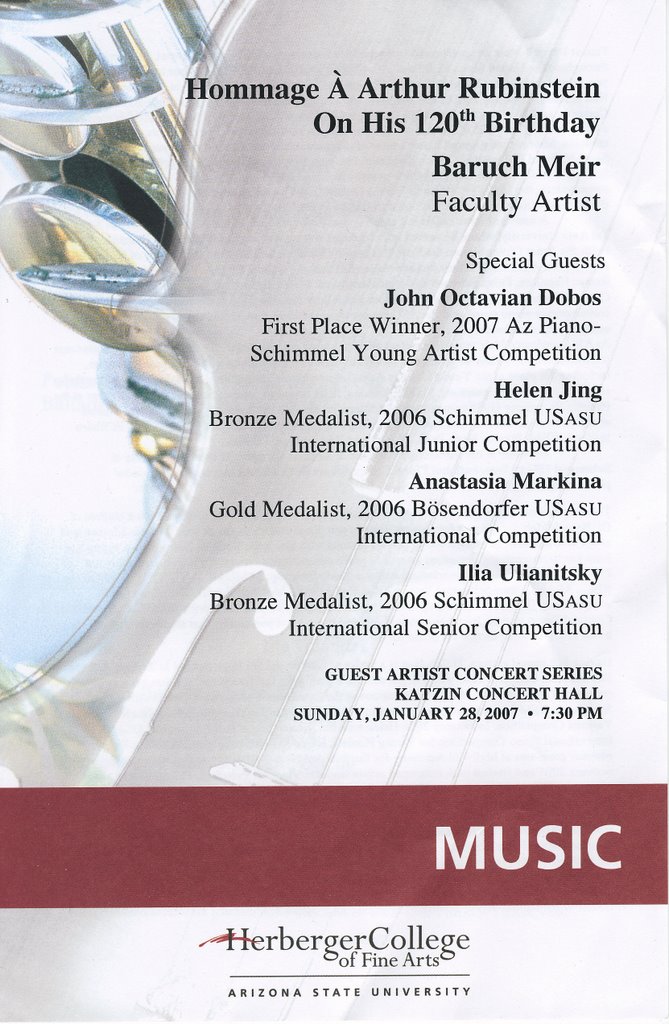
Chopin piano recital

Patricia and I went to an all-Chopin performance at Katzen Hall (ASU campus) on Sunday night. (This was after a nice early dinner at the Z Tejas in Tempe - the chicken quesadilla and chile verde were fine indeed.) The premise was the 120th birthday of Arthur Rubenstein, who recorded mucho piano works by his Polish compatriot. Short lecture followed by a film of Rubenstein (which could have been shortened a bunch or skipped altogether). The playing was most enjoyable; we liked the faculty performer plus Ilia Ulianitsky and Helen Jing.

An extremely pleasant evening. Small crowd, which is hard to figure. Info on Rubenstein is here.

Sunday, January 21, 2007

The Painted Veil


Patricia and I went to this movie on Saturday (January 20). Actually didn't intend to go to this movie but the time was convenient. Amazingly enough, this makes two movies in a row that I really liked.

In this one, an English bacteriologist is back home in London for a short visit. An immature but aging woman - heck, she was 25 and unmarried - is feeling family pressure to get married. So they're both feeling the clock ticking and get married. He loves her, but not vice versa. They go back to Shanghai where she misbehaves. As punishment, he volunteers to serve in a town ravaged by a cholera epidemic, and forces her to go along. In that setting, they are able to see the finer sides of one other.

I liked the leads (Naomi Watts and Ed Norton) and thought they did a great job. I actually cared that they might find some happiness, which I guess is what a good movie is supposed to do.

I liked the setting - 1920s China - with Nationalist overtones, anti-Western sentiment, etc. Great photography. Based on a novel by Somerset Maugham but I don't know whether it's faithful to the novel. I intend to find out. I guess there have been a couple previous movie versions, including one from the 1930s starring Greta Garbo and Herbert Marshall.

Finished a nice evening with a light supper off the bar menu at The Roaring Fork. A good place. Sometime we need to actually have a dinner there.

Enemies, A Love Story (Isaac Bashevis Singer, 1972)

Listened to this book on tape. Never read anything by Singer before and probably will try more. Very odd plot here. Polish Jew hides in a hayloft for three years during Nazi occupation. Had bad relationship with wife before this; the wife and his two children are shot in a Nazi camp. He marries the peasant/servant girl who fed him and sheltered him in the hayloft, and moves to New York (Coney Island). But he's not in love with her; instead is in love with the beautiful and mercurial Masha, who lives with her mother.

He lies to the peasant that he is a book salesman and needs to travel regularly; spends this time with Masha. Then his wife shows up in America - she had been shot but somehow survived. Somehow they have a very strong relationship after their experiences.

I can't say I've read anything quite like this. Interesting to have the perspective of camp survivors in America. Some of the dialogue, especially with Masha, is quite funny. Overview of loss of faith by folks swept up in the camps.

I guess this was made into a popular movie pretty recently, I need to check it out.

And why was there such a large Jewish population in Poland? Doesn't seem like a natural destination. This book talked about how the Jews were blamed for the black death in the 14th century - poisoning the wells, the usual scapegoat stuff, etc. - and were welcomed by Polish nobles while being expelled from western Europe. The Polish nobles needed the administrative skills etc. No idea if that theory is accurate, there probably were plenty of other persecution incidents (including Polish when it was convenient for them).

Monday, January 15, 2007

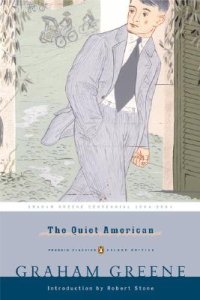
The Quiet American (Graham Greene, 1955)

An English reporter living in Viet Nam during time of fighting between French and Vietnamese (Communist) is the narrator. Mid-1950s. The narrator had pretty much "gone native," living with a local woman, regularly taking opium, etc. An American arrives as an economic attache; actually doing undercover work for a "third force" - an unreliable local warlord - in an effort to stave off the Communists. American steals girl from narrator (to his great disappointment) and saves the narrator's life when they are stranded in open country. Narrator recognizes unreliability of naive American, could be said to have a hand in the American's assassination. But he does get his woman back.

I liked this a lot. Never read anything by Graham Greene before and don't know a thing about him. The introduction to this edition of the book said he grew up in the public school tradition of service and would have believed in Britain's historic international role. I'll read more. His bio is here. The book gave one man's take on the situation in Vietnam.

I was listening to a song by Nanci Griffith, who I like a lot, at the gym this evening. She is active in Vietnam veterans' matters. (In fact, during her appearance at the Alaska Folk Festival in 2006, it was reported by one Carol Gales that she yakked about that type of thing too much and didn't sing enough.) Anyway, she mentions the name of this book and the author a couple times in one of her songs about Indochina.

Sunday, January 14, 2007

Piano competition


For the second year in a row, Patricia and I attended the Schimmel Bosendorfer USASU piano competition (now that's a mouthful) at Katzen Hall at Arizona State University. This year, we suckered Paul Jr. into accompanying us. The concept is great for the audience -- it combines interesting, nicely-performed piano music with a competition setting. There are three divisions. The "junior" group is fun - kids 16 and under - absolutely amazing what they can do. I include the program notes for Min Soo Hong, who was the most entertaining perfomer of the entire evening. A 13-year-old kid who really went for it. The "senior" group is up a distinct level in quality. I also include the program notes for a young lady from this group who performed well, but she was especially noticeable because of her, let's say, unusual facial expressions and overall contortions.

The adjudication sessions are open to the public but we didn't make it this year. Patricia went last year and I hope we can get to one next year.

(Note the photo of the happy attendees taken with the camera in my new phone - a new era for me in photojournalism.)

This is a nice event which likely will recur annually. I hope it does.

Wednesday, January 10, 2007

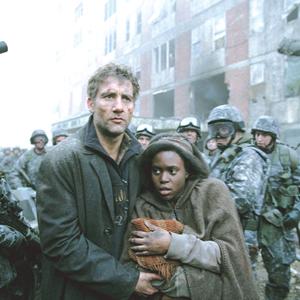
Children of Men

Rare occurrence - we went to the theater and saw a really excellent movie. The premise is that the entire world lost fertility in 2009. The movie is set in Britain in 2027, by which time the absence of children has been felt around the world in similar ways. Basically, people have given up hope - they see no future. Riots, destruction, "the end is near" behavior. Britain "soldiers on" and is seen as a relatively safer haven; thus, it is swamped with immigrants. Britain responds by agressively rounding up, and deporting, illegal immigrants. You can read about the lead characters and the plot in reviews such as this one. A former activist becomes a bureaucrat; he ends up sheperding a pregnant woman (pregnancy being a miracle) to a safe haven while fending off a terrorist group and police.

It was just excellent. There was a chase scene where a car is rapidly reversing down a road while trying to evade motorcyclists; I still can't figure out how they filmed it. Near the end, the lead actor is escorting the pregnant woman out of a building where the terrorist group has holed up and the army is shelling with tanks etc. This definitely was the best scene in the movie. Thoughts: 1) It reminded me of the Stalingrad book - great filming of fighting that goes beyond floor-to-floor urban fighting, it's literally room to room. 2) Again, there was something unique about the filming - it was like a single camera following the action, something like you would think a film crew embedded with the military would do. 3) The scene where he walks out with the woman through the terrorists and then through the military - the identical reactions of the fighters - this is really well done.

Chris, Patrick and Paul Jr. accompanied Patricia and me. Then we had dinner at Elephant Bar. (Where the service didn't measure up to the movie.) But it was a fine outing.

Saturday, December 30, 2006

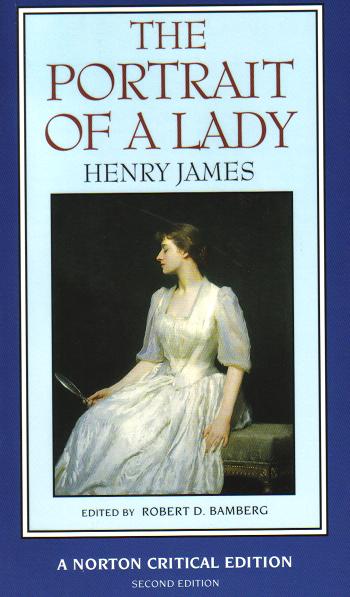
Portrait of a Lady (Henry James, 1881)


This is considered one of James' best novels. A young American lady (Isabel Archer) is brought to England after her parents die; she meets various upper crust types and receives a large inheritance from her uncle (at the request of her cousin, who was in love with her and thought the money would make her independent). She turns down marriage proposals from an American businessman and an English lord - supposedly wants to be free, explore Europe and beyond, etc. Ends up heavily influenced by an American expatriate (Madame Merle) that she meets in England, and marries another American expatriate (Gilbert Osmond) mostly through Merle's influence. She was used, in large part for the money that was supposed to help her remain free.

The book was pretty long, but very little action - lots of conversation, the heroine thinks about things etc. Lots of James' usual portrayals comparing and contrasting American and European ways (he lived on both sides of the Atlantic). In the end, I'm not a huge fan of his.

But this book was quite good. They made it into a movie in 1996, but it was criticized as too "talky." Small wonder, it's hard to see how this would transfer well to the screen.

Sunday, December 10, 2006

After the Victorians (A.N. Wilson, 2005)

Third book by Wilson within the last year or so, and I have really enjoyed each. This one starts around the time of Queen Victoria's death (1901) and traces U.K. history into the 1950s. I really can't tell the strategy for this book. Wilson seems to know quite a bit about almost everything, and throws it all in. So there are portions that lose me - discussions of plays, architecture, design, science - but in the end it all works just fine as far as I'm concerned.

I like the guy's writing because he endlessly puts opinions out there - whether or not you agree, it's interesting and makes you think. It was fairly long, 500 pages, and good material for reading at the gym.

The story goes through World War I; celebrations of empire at a time when its demise was pretty much inevitable; disturbances in Ireland; World War II; lots about Churchill (who is more amazing every time you read about him); loss of empire (India in particular); etc. He walks through the thesis that England quite possibly could have made peace with Hitler after the fall of France; Hitler did seem to have a reluctance to attack England and an affinity for things English; it was believed he may have been content to dominate Europe/Western Asia and let England continue to run its empire at the margins. That quite probably is fantasy, but what is true is that England watched itself become irrelevant while behaving quite heroically throughout WWII.

It's interesting to hear him discuss the English schools and the administrative class that rose to prominence in the latter days of the Empire. I'm reading a book by Graham Greene right now, he's described as coming from that world.

Wilson's bio of Tolstoy is summed here.

Tuesday, November 28, 2006

Stalingrad (Antony Beever, 1998)


So much has been published about Stalingrad, but I certainly never get tired of it. This author supposedly had access to previously-unavailable archives in both Russia and Germany. Beever goes into quite a bit of battle detail, but focuses more on the “way it felt” for attackers, defenders, civilians. Many quotations from letters and diaries. Some of the letters were from German soldiers and were in Russian archives after the Russian victory; the Nazi censors wouldn’t have allowed them to reach Germany.

The story is pretty familiar. Nazis sweep across southern Russia, but too late to polish off Stalingrad in 1941. Luftwaffe levels the city, unintentionally making a great defensive zone for the Russians. Russians make a stand in Stalingrad. Often the defenders’ morale was bolstered by commissars standing behind them with pistols, shooting anyone who flinched. Building-by-building, floor-by-floor fighting. Snipers. Civilians (including children) surviving in the rubble, with techniques like crawling out at night to take the “bread bag” off dead Russian soldiers. Horrific winter weather. Cruelty to prisoners – but what to do when fighting men lacked shelter and food? Lice. No fuel on the steppes. Minimal care for numerous wounded.

He describes how the Russians encircle the Germans – who flipped from being on the verge of winning to starved and frozen encirclement in the Kessel. The ineffectual air bridge bringing in hopelessly inadequate supplies. Russians fighting in German uniform (probably with more motivation than even the Germans, as the Russians closed in). Hitler’s interference in military matters. Propagandists on both sides. Christmas in the Kessel, as starving soldiers saved bits of bread to give as gifts to celebrate Christmas “in the German way.” A German artist drawing the “Fortress Madonna” for Christmas on the back of a captured Russian map (there being no other paper).

The book wears you down. Just unbelievable what happened here.

More info on the battle can be found here.