"To compensate a little for the treachery and weakness of my memory, so extreme that it has happened to me more than once to pick up again, as recent and unknown to me, books which I had read carefully a few years before . . . I have adopted the habit for some time now of adding at the end of each book . . . the time I finished reading it and the judgment I have derived of it as a whole, so that this may represent to me at least the sense and general idea I had conceived of the author in reading it." (Montaigne, Book II, Essay 10 (publ. 1580))

Sunday, August 28, 2016

Ready Player One (Ernest Cline, 2011)

Book club selection (via Lon; session held August 28, 2016).

Gamers in dystopian future compete for stupendous prize to be awarded to winner of virtual reality contest left behind upon death of eccentric creator of "OASIS" - which is a virtual world where unhappy folk (i.e. most people at that time) prefer to escape whenever possible.   Protagonist is pretty much a trailer park loser from busted family; he works to win the contest along with other outcast-types in competition against lavishly funded (and evil, naturally) corporate forces.  Creator of the game was obsessed with 1980s pop culture, so the book is riddled with these references (which worked just fine).

Original (or so it seemed to me - a nonreader in this genre).  I enjoyed the story line, and it definitely tugged me along.  Kind of a morality play; felt like a 30's movie in some ways.

So I liked it . . . I liked how the lines between the "real" and "simulated" worlds were blurred.  Also a situation where magic and super powers somehow make sense.

Some aspects I didn't like as much:

For one thing - and I realize they need to sell books - why is the future always a dystopian hell in these books??  In reality, everything is constantly getting better!  Yet here comes the same tired concepts of rampant pollution, overpopulation, food supply issues, blah blah.

Evil corporations - unoriginal.  Media portrayal affects voter perception, unfortunately.  Discussed at length in this book, for example.

Og - blatant deus es machina.  Similarity to "Oz" probably not a coincidence.

Downtrodden protagonist faces long odds; romance; check-the-box diversity; etc.

Monday, August 15, 2016

Bourgeois Equality - How Ideas, Not Capital or Institutions, Enriched the World (Deirdre McCloskey, 2016)

650-page finale to the author's three-volume set (first book is discussed here; second book is discussed here.  She expands and develops the themes from the first two books.

Author is "emerita distinguished professor of economics and of history, and professor of English and of communications" at University of Illinois at Chicago.  Her breadth of knowledge and experience shows throughout.  I've never taken an econ course and remain marvelously illiterate on the topic - but coming into the subject in an unscientific way late in life, I do have a strong impression that econ really is about "living" in a very broad sense . . . about considering all the variables that affect or constitute human behavior . . . deep knowledge of history and literature, as McCloskey clearly brings to bear, adds invaluable depth to the discussion.

Her basic idea - a detailed exposition about how ideas matter - about how liberating regular folk to "have a go" (her phrase) - led to the unbelievable enrichment of the last 200 years, to the great betterment of so many.  Human potential, unleashed and respected, is beyond marvelous.

I like how she goes after conservative forces on the left and on the right.  I think I'm getting a better handle on this.  Aristocrats or plutocrats or military leaders with plenty of financial resources and/or power don't benefit from disruption or a lifting-up of regular folk.  University professors, bureaucrats, priests, columnists and politicians sit on their perches - not themselves needing to be productive (or, heaven forbid, to generate a profit) - they don't benefit from disruption or a lifting up of regular folk.  Constant sneering from these sources at those engaged in commercial activities - coming from those ultimately supported by it!  Unions, regulations, minimum wage, tariffs, crony capitalists, etc. - regularly employed to prevent regular folk from having a go.  Especially as these organizations mature and become focused, first and foremost, on their own turf.

Useful discussion about why capitalism (a term she considers misleading - she prefers "trade-tested betterment" - in significant part because "capital" is so small a factor in what she calls the Great Enrichment) - anyway, capitalism so obviously is a success overall, and so obviously a success in improving the lives of the regular/poor folk -  yet it draws endless opprobrium.  Gives lots of useful history on this. Including reviewing literature/arts, which turned anti-bourgeois starting 1848.

She uses the idea of "waiting for the third act" as a helpful way of thinking about how entrepreneurs - after enriching (maybe) themselves - end up bestowing far greater riches on regular/poor folk.  If I pay $600 for an iPhone - Steve Jobs (or Apple stockholders) capture how much - let's assume $100 in profit - but I capture far more value from the device than I paid.  A Yale study, for what it's worth, estimates that entrepreneurs capture just 2.2% - whatever the number, it's a great bargain for all of us!

But count on academics, politicians, media types to keep focusing only on (sneering at) the "first act" - without considering the longer term - how else to keep the ignorant whipped up?

She continues her useful elaboration on the positive way that virtues fit into the commercial life.

Also debunks the "Eden" myth - such a favorite of the conservative right (but also conservatives on the left, now nostalgic for the 1950s economy, of all things!!) - the myth being the utterly false belief in how great everything was back in the old days - one ex. being the myth of the contented villagers living in close harmony with each other and nature - no reader of history slightly believes this.  But politicians endlessly cite variations on this theme, and human nature seems to respond to the myth.

Also useful:  her discussion about today's #1 hobby horse - "inequality".  Since no one can continue to seriously argue that trade-tested betterment, or capitalism, dramatically aids the poor/regular folks - and dramatically better than any other system including charity or socialism - the sneering and complaining shifts to "inequality".  (See discussion above about low capture rate by entrepreneurs.)  But envy works so very poorly - except to attract votes from the ignorant.

She emphasizes that things are quite good in many countries  as a result of the bourgeois deal - but this can quickly be reversed.  Policies and governments matter, a great deal.  Countries like the U.S. (and others - Canada, Scandinavia, etc.) are wealthy enough and have generated enough momentum to continue at a comfortable level - if slow-growth - despite increasing stupidity in the political arena (see e.g. politicians braying for protectionism, free college, minimum wage etc. in current presidential campaign).  For so many other/emerging countries - adopting the same stupidities - they will never get off the dime.

Per McCloskey - above all else, ideas - and rhetoric about ideas - matter.

I think the three volumes are incredibly valuable, and would be worth anyone's time.  (And it does take some time.)

Wednesday, July 20, 2016

The Only Rule Is It Has to Work: Our Wild Experiment Building a New Kind of Baseball Team (Ben Lindbergh and Sam Miller, 2016)

Book club selection (via POC; session held July 17, 2016).

Authors are well-known baseball statistics guys, including stints with Baseball Prospectus.  A situation arises during one of their regular podcasts - almost like a dare - they agree to take on responsibilities with an independent league team, the Sonoma Stompers.  The idea was that they would have authority to select players and implement cutting-edge strategies based on statistical analysis.

That was the idea.  They find out that institutional inertia is powerful.

Interesting, useful; I pay lots of attention to baseball for so many years now (55 and counting), and had plenty of new insights based on reading this.

And our reading group has a couple guys who have lived the life, and had interesting things to say about all this.

Some thoughts:

1.  Sonoma is a town we know from vacations (just there in April as a matter of fact); team stadium just a couple blocks north of the town square; adds to the enjoyment of the book.

2.  Good job of explaining the gap between the independent leagues and affiliated ball - these players really are on the cusp, pretty much without exception.  In plenty of cases, deciding whether to play one more season for near-zero chance of advancing, or give up the dream and get a "real" job.

3.  The authors' interactions with the first manager (Feh) - very interesting - how  instincts, clubhouse experiences matter.  The stat guys won't anticipate that seemingly innocuous decisions will have a big morale effect, at least based on how players still tend to approach the game in 2016.

4.  Some interesting details about how the authors unearth players with unrecognized potential.

5.  But all in all, the authors had less control than one would expect based on the book blurbs.  Harder to initiate changes than they expected.

5.  One problem with the story:  sample size is too small to judge effectiveness.  One season, and a very short one at that.  The book publicity oversold what was going on here.  Which was a minor shame, since the book stands up quite well anyway.

6.  Unusual things - one of the players comes out; Jose Canseco signs for a short stint.

Friday, July 15, 2016

Jude the Obscure (Thomas Hardy, 1895)

My first Thomas Hardy novel; I expect to read more.

This was his final novel; some speculate he was discouraged by adverse reaction to it, though I don't find that terribly plausible (unburdened by any knowledge on this topic, however).

The book appears on "best novel" lists; it also appears on "most depressing novel" lists - both rankings make sense.

It made me rather unhappy quite regularly, yet tugged me along.  I'd recommend it, although initially I felt otherwise.  The characters are interesting, complicated - no one-dimensional villains.

Themes:  difficulty of lower classes to access higher education; class distinctions; difficulties with the institution of marriage as then in force; the Church; smothering effect of these.  In 1895 - controversial.  But very thoughtful and sympathetic; perhaps even "ethical," I'd say.  Modern, but not modern (1895, after all).

Sue Bridehead - clear-thinking, delightful heroine, but fragile, and endures too much.

Jude Fawley - always working uphill. Working class with dreams of academia (or clergy); makes a living, such as it was, by working as a stonemason.  From childhood, loves the town of Christminster as a place of dreams or opportunities.

Jude's schoolmaster for a brief period in early childhood - Philottson - moves to Christminster at beginning of the novel - later re-enters the story - also shows quite a bit of capacity for independent thinking but is duly punished.

Arabella - a survivor!

Father Time - one of the grimmest characters I've ever encountered.

Sunday, July 10, 2016

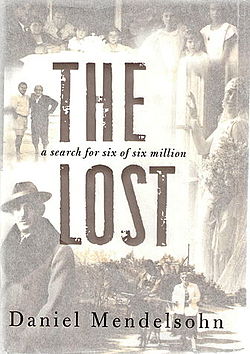
The Lost - A Search for Six of Six Million (Daniel Mendelsohn, 2006)

Wasn't really looking for *another* Holocaust book.  But PJ was recommending this pretty strongly, so I thought I'd be a good sport and take it up.

Very glad that I did - some perspectives that I found quite unique.


The author is a professional writer - NY Review of Books, NYT magazine, that sort of thing - and became deeply interested in history even as a child, he thinks due to influence of his grandfather.  Family origins in Bolechow, Poland; many emigrate as things get tough; six stay behind and disappear as Germany takes over following Hitler turning on Stalin in 1941.  Limited and not always consistent information is available about how the six were liquidated, but author decides to search for more.

Travels to Bolechow; then Australia, Israel, Scandinavia.  Reconnects (or connects) with photographer brother who seems to do very nice work (wish the photos had been given more prominence in the book).

Author uses a meandering storytelling style - takes some patience - 503 pages - but well worth it.  Interactions with survivors; some pretty amazing coincidences enable information to be discovered; very powerful as author descends into the kestl.

Particularly useful to me - he pulls together threads I'm pursuing - family history research; weaves Old Testament stories (particularly Cain & Abel, Noah, Abraham), along with interpretations from two Torah commentators, into his narrative; Jewish history in eastern Europe; stories of the Polish borderlands (Galicia), last flickering remnants of the old Habsburg days; plenty of tension among Poles, Ukrainians and Jews but at least they could live together and function for the most part (other than the occasional outbursts, which were awful enough).  Jews now all gone.

The awful episodes during the several Aktions, including at Dom Katolick. Hidden in a teacher's house.  Polish boy makes the mistake(?) of falling for a Jewish girl.  Uncle Shmiel loses his permit to run his truck.  Stuff that happened with Jews under 1930s German diktats (with plenty of local collaboration) - wow.  Ukrainians take advantage.

Searching for the personal detail that prevents - ok, only delays - a person (pretty much every person, ultimately) from being entirely, utterly forgotten.  Searching for how it might have felt (not just how it happened).

Author states that his grandfather was renowned for his storytelling ability, and he tries to describe his grandfather's method; then describes his dilemma about how to shape the story he is learning about in his researches . . . of course he's signalling that he will be using his grandfather's method to tell this tale.  Which he does, very effectively.

Tuesday, July 05, 2016

An Autobiography - or - The Story of my Experiments with Truth (M.K. Gandhi; written 1925-1929)

An interesting and useful look at Gandhi in his earlier years, by Gandhi.

I'm always suspicious of autobiographies - by definition the author cannot be unbiased - but there is so much going on in this one - glimpses into both the author and late 19th/early 20th century India.

I think he is pretty honest in using the term "experiments" (if that's an accurate translation) - clearly inquisitive, innovative, more than willing to try atypical approaches.

Some threads:

1.  Marriage - at a very young age.  Wife pretty much uneducated.  He spends quite a bit of time away (England, South Africa, etc.).  Later decides to abstain from knowing his wife (Brahmacharya).

2.  Diet - avoiding meat, milk.  Lots of fruits and nuts. Experimenting to the point of putting his health at risk.

3.  Medicine - again, accepting or not accepting medical advice - taking risks - to the point of jeopardizing his health.

4.  Child-rearing experiments; often separate from his own.

5.  Education - clearly a bright student; progresses through India, then onto England.  Educational experiments in Ashrams.

6.  Important years in England - I had forgotten about this if I ever knew it.

7.  Difficulties in establishing a law practice in India; accepts an opportunity in South Africa.  Builds relationships there; gains experience in dealing with mistreatment of Indian population (starting with getting thrown off a train).

8.  Religion, and more religion - gaining some familiarity with Christianity (starting in England); deeper understanding Hindu principles.

9.  Devoted to living simply; third-class train travel; sanitation; encouraging folks to clean up!

10.  Boer War - organizes ambulance corps - believed in working within the system and respecting the government (at least up to a point).

11.  Development of Satyagraha principle, starting in South Africa.

12.  Getting involved in Congress party.

13.  Very interesting issues in connecting with Muslim (Musselman) leadership; made me think of how poorly all this worked out, per discussion in this book.

14.  Early confrontations, let's call them, with British authorities in India.

15.  More experiments - in self-sufficiency - spinning wheels.

Not saying all these ideas played out well - but the guy clearly had immense leadership and imaginative capabilities.

Gift from Dharma, much enjoyed, lots to think about.

Saturday, June 25, 2016

Introduction to the Qur'an (W. Montgomery Watt and Richard Bell - 1970)

I would love to have a little better sense of the Koran (using spelling I'm most familiar with); have tried to approach it via a book or three (here, for example); not making much headway.  This book was favorably reviewed in part because it was released before the escalated tensions that seem to make authors overly cautious with their wording in more recent works.

But this one didn't help me much.  It was very focused on the text - pulling out various points at a greater level of detail than I could (or perhaps wanted to) handle.   There was quite a bit of discussion around historical context, but I would have preferred more.

Little or no progress based on this.

Wednesday, June 22, 2016

Year Zero - A History of 1945 (Ian Buruma, 2013)

Another look at the immediate aftermath of WWII - the amazing year of 1945 - insights into how countries tried to start over.

Often with significantly different demographics than obtained prior to the war.

I rather expected this to cover similar ground as this so-helpful work by Tony Judt - but the overlap isn't all that much - Buruma covers more countries (Asia, for example) but in less detail than Europe-focused Judt.  And he pretty much sticks to his "Year Zero" theme; Judt covers a longer time span.

There was a significant amount of "retribution" - but also a practical viewpoint - plenty of people who hadn't behaved all that well now were needed to make these countries work - an active process of forgetting, or overlooking, was pursued in so many cases.  As Judt discussed, this did lead to some backlash later.  But I don't know how these places could otherwise have functioned.

Returning POWs or campers often not all that welcome - or sympathized with - home front folks had their own problems (and opportunities!)

Useful discussion of a difficult situation that I think tends to be overlooked - huge decisions with corresponding consequences came down as WWII closed and the postwar period commenced.

Tuesday, June 14, 2016

The Sun Also Rises (Ernest Hemingway, 1926)

Book club selection (via Nick; session held June 12, 2016).

Last read back in 2005, per here.

While I wouldn't change the ranking expressed in 2005 regarding the three Hemingway novels most familiar to me - I will say that I found this novel quite a bit more interesting than I did back then.  Not entirely sure why.  Brett and Jake with a quite-nice love story even if it never would work; other men more or less used by Brett, if perhaps willingly. Robert Cohn; the count; Mike; sidekick Bill. Romero, Montoya.  Details around Paris; contrast with Spanish national character elements.

The bullfighting sequences are entirely foreign to me - can't imagine why folks enjoy - but then there's American football, boxing, etc.

Thursday, June 02, 2016

The Transylvanian Trilogy - Volume I - They Were Counted (Miklos Banffy, 1934)

This sounded interesting, and I was willing to give it a try as part of an ongoing effort to get a better picture of eastern Europe, Balkans, etc. (for example, this, this and this within the last few months).

Quick read; debatable whether I'll go on and read the last two parts of the trilogy.

Author is telling a story of Hungarian aristocracy in the years just before World War I (as a result of which their world broke, irretrievably).  Two cousins are the main characters:  Balint Abady and Laszlo Gyeroffy.  They are headed down different paths.

Sometimes draggy but generally interesting discussion of early 20th century politics in this corner of the world - feeling pushed around by the emperor in Austria; the "Dual Monarchy" not seeming very well balanced.  Some are dreaming of incorporating Balkan states into the empire.  References to 1848 and 1867 episodes and influence on Hungary, Transylvania; Kossuth; but no references reaching back to Turkish occupation etc.

A reminder of how closely integrated this world was with all of western Europe; perhaps now the effect of the Iron Curtain is fading a bit and that integration is somewhat restored?  Romanian minorities (including folks on Balint's estates).  A sense of the geography of Transylvania - hinterlands even by the standards of these countries.

So much of the talk by the politicians would sound right at home in 2016 presidential campaign - phony patriotic appeals, identity politics, payoffs, etc.

Descriptions of of old houses - originally built with fortifications.

Balint interested in Adrienne and Laszlo interested in Klara.  Author burns a lot of time on this and it's the weakest part of the book - these portions are how I imagine a Harlequin romance would read.

Wednesday, June 01, 2016

Midnight's Furies - The Deadly Legacy of India's Partition (Nisid Hajari, 2015)

Interesting, useful.  Seemed like a good follow-on to this novel.

August 15, 1947.  Nehru, Jinnah, Gandhi, Patel.  Mountbatten.  Focuses on the run-up to, and aftermath of, the "Partition" - with enough background to help make sense of this for general readers like me.

Perhaps it's just this author's presentation - but in the un-resolvable discussion about the relative importance of individual leaders and what I'll call larger historical-social movements - as applied to these years, the role of the leaders seems unusually important.

Reactions:

1.  Of course everyone involved here can be subjected to criticism, and the author almost goes out of his way to balance his criticisms of the each "side."

2.  But I keep thinking that the fundamental error here was Jinnah insisting on a separate country for Muslims - even though he perhaps didn't even think it realistic in the early going - but when Britain faded and the opportunity came, he stuck to the "separate state" principle.  By definition, that results in the leadership (ultimately on both "sides") practicing the worst kind of identity politics - educating the public that the two groups can't get along and must be separated; endless opportunities to demonize the "other" - all the bad things about mixing state-and-religion that so much of the rest of the world (though certainly not all!) had largely worked through centuries ago.

3.  And it's a hopeless struggle in any event - as one starts dividing by religion, where does it end?  Among other examples, check out the role of the Sikhs here.  If religions need a state, why not Sikhistan?

4.  Still - had Britain retained any type of staying power - seems that partition likely would have been avoided.  Britain simply out of resources in the immediate aftermath of WWII.  It was obvious to Britain that things were proceeding down a dangerous path, but - in response - Britain accelerated its departure.  Quickest path "out" was to accede to partition despite the dangers.  Such an unusual situation.

5.  Lots of detail about the refugees, the slaughters, etc.  That part gets a little tiresome but helps explain why the two countries remain at odds.

6.  Gandhi past his prime, trying to stop the violence, still capable of swaying public opinion.  Assassination comes from Hindu right-wing.

7.  (Courtesy of KHG), I've been reading big chunks of Steve Coll's Ghost Wars - where among other things he explains Pakistan's role in radicalizing, funding, arming fundamentalist Islamic groups across the Afghan border - including the Taliban and OBL - Pakistan started using these folks for proxy wars against India going all the way back to Kashmir in the first year post-Partition - some very real and very negative consequences.  This author gets into the same subject matter.

8.  So much negative energy between the two countries from Partition down to the present.

Seems a shame that the leadership couldn't find a way to create a federal (or whatever term applies) structure that encouraged folks to work together inside a single country - without demonizing any "other" group or individual.  That should have happened.  No doubt there would have been plenty of growing pains, but it doesn't take much imagination to see what actually happened as far worse.  Now to make the best of it . . .

Wednesday, May 18, 2016

Wildflower - An Extraordinary Life and Untimely Death in Africa (Mark Seal, 2009)

Book club selection (via Emily; session held May 15, 2016).

The main story line revolved around a star-crossed, I'd say, couple - both living in Africa and connected to the Kenyan community.  Married in 1961.  Alan Root as the outgoing, charismatic, innovative nature film maker; Joan Root as his do-everything self-effacing back-up.  The author never tires of describing how talented and beautiful she was.  The couple buy a house on Lake Naivasha - which we learn is very scenic - and later under threat from development and poaching.  Successful film-making continues.  Then Alan meets Jennie, and the relationship part - which always seemed frayed - broke.

The Roots were pioneers - maybe too strong of a word, but not much if it is - in nature films.  Interesting to read how they went about it; major success on BBC; they somewhat created the genre that we now take for granted.  Alan the creative force.  They met up - and in some cases advised/mentored - folks that became household names - Leakey family members, Diane Fossey, Joy Adamson.  British royalty.

As the years go by things change drastically in Africa - population pressure; rose-growers crowd the lake; huge market for poachers (China?); Joan, perhaps needing a cause post-Alan, gets heavily involved in her view of conserving the lake area.  Some iffy fellow named Chege is her lead enforcer.  As the book title conveys, she ends up getting offed - no clear reason - though she wasn't particularly young anymore.


Friday, May 06, 2016

Agents of Empire - Knights, Corsairs, Jesuits and Spies in the 16th-Century Mediterranean World (Noel Malcolm, 2015)

To me - this is how history should be written.  Author selects a relatively narrow focus, researches it to the nth degree, tells the story with plenty of context.  History comes to life.

Exact opposite effect of this plodding compendium - which, interestingly enough, overlapped a fair amount with "Agents of Empire".   But Greengrass's book is just unreadable - lacks focus - tries to address whatever was happening in pretty much every decent-sized country in Europe over too many years - too much.

Author's focus area here:  he runs across a reference to a contemporary description of Albania - written in late 16th century - apparently nothing like this had surfaced - so he tracks it down, and follows the trail from there.  The author of the 16th-century Albanian description was a member of a family that somehow insinuated itself - starting without any particular resources or prestige - into the foreign affairs (and/or diplomacy and/or spying) in Spain, England, Poland, Austria, Papal States, Moldavia, Wallachia, Transylvania, Hapsburgs, Ottomans, Venice, etc.  (One of the family members was killed at the Battle of Lepanto, interestingly enough.) (One became a Knight of Malta.)  These folks sometimes served as diplomats or translators, which - even then - often bled over into intelligence-gathering and outright spying.

After reading several books about this era - or perhaps because of reading them - this book finally helped make sense of some of the relationships here.  Venice dependent on Ottomans for trade but of course traditionally Catholic.  Wary of the too-powerful Hapsburgs - either the Spanish or Austrian branches.  Pope trying to jump start the Counter-Reformation; one method is to try to put together anti-Ottoman alliances (even, in bursts of optimism, coalitions that would include both Catholic and Protestant states).  But France often allying with Ottomans (which seems odd but serves purpose of countering Hapsburg power).  Spain holding onto Italian territories, great wealth from the Americas, troubles in the Netherlands, dealing with pirates/corsairs.  Ottomans interested in buffer states (Moldavia, Wallachia, Hungary) and sucked into exhausting war with Persia in the east.  And already worrying about an emergent Muscovy.  Etc.  I find this era endlessly interesting.

And the Albanians!  Sitting in the pathway - traditionally European, dominated by Ottomans, playing both sides.  Often serving as janissaries and rising to senior levels in Ottoman administration.  Living in that area couldn't have been easy.

Author does a really effective job sifting through records and correspondence - more survives than I would have ever guessed - but author also avoids conjecture and grand conclusions.

Was surprised to see that this author had written this very interesting work on Bosnia (another somewhat fairy tale location).

Much worth reading.

[33, 81, 98, 150, 160, 169, 196, 208, 228, 302, 309, 320, 323, 341, 349, 402]

Wednesday, April 27, 2016

Cities of Gold - A Journey Across the American Southwest (Douglas Preston, 1992)

Nelson and Preston
Book club selection (via CPG; session held April 24, 2016).

Didn't know much about the American southwest when we moved to Arizona in 1986.  This was one of the earlier books that I read on the topic; had forgotten how much I enjoyed it.  Was very happy to have an occasion to re-read.

This book definitely had given PJ and I some ideas about road-trips - there were many trips to eastern, north-eastern, south-eastern Arizona in the mid-1990s, with five so-young children in tow - wonderful memories.

Preston got the idea that it would be useful to travel the route that Coronado took - in 1540 - up from Mexico into what became the United States.  And decided that doing it on horseback was a more faithful re-creation.  He hired "Eusebio" - a wood-cutter posing as a wrangler.  But the main companion was photographer and jack-of-all-trades Walter Nelson.

I keep thinking this book should be required reading for anyone residing in the State of Arizona - it's a travel tale (with plenty of horsey misadventures) that threads in so many elements of the state's history and geography.  He wanders around a bit - both with the horses and the editorial choices - but wasn't that the point here?

There truly is nothing like the New Mexico scenery.
San Pedro; Salt River; Coronado Highway; ranchers; tales of Apache, Navajo, Zuni, Hopi; visiting the pueblos where rather unfortunate encounters took place.  Spanish were of course looking for the seven cities of gold - this was just a few years after Cortez and Pizarro hit it big.

I found the dialogue - the voices - very authentic.

Just like the first time I read it - all I want to do is get out there.  Don't know how to make that happen however.

Wednesday, April 06, 2016

Daniel Deronda (George Eliot, 1876)

Final novel for Eliot; per here and here, I do like her work very much.

This is rather long - 695 pages - but Eliot is pretty much always interesting.  There are two major story lines - beautiful-but-poor Gwendolyn Harleth; spoiled, immature, but with potential - enters into a loveless marriage.  Daniel Deronda lives with his uncle - generally quite happily - but he doesn't know details of his parentage and wonders about it, plus tends to be the selfless sounding board for his friends to the point where he doesn't really have peer relationships.

The paths of Harleth and Deronda intersect in various ways.

Deronda is increasingly interested in Judaism due to a series of events - including getting to know Mirah and her brother.

Mirah lives with the family of Deronda's friend (Hans).

Story lines are set in English aristocratic society of the 1860s, with many topical references (so I was grateful for useful end-notes).