"To compensate a little for the treachery and weakness of my memory, so extreme that it has happened to me more than once to pick up again, as recent and unknown to me, books which I had read carefully a few years before . . . I have adopted the habit for some time now of adding at the end of each book . . . the time I finished reading it and the judgment I have derived of it as a whole, so that this may represent to me at least the sense and general idea I had conceived of the author in reading it." (Montaigne, Book II, Essay 10 (publ. 1580))

Tuesday, November 15, 2016

Do Androids Dream of Electric Sheep? - Philip K. Dick (1968)

Book club selection (via PJr; session held November 13, 2016).

Author is consistently creative, ahead of his time.  This book - primarily about exploring the line between humans and high-functioning androids - seems quite timely almost 50 years after being written.

Protagonist is a bounty hunter - paid to "retire" renegade androids who are increasingly difficult to distinguish from humans in post-nuclear war San Francisco and environs.  Android manufacturing company based in Seattle (Rachel's company).

Chickenheads - Isadore.  Kipple.  Earth in decline; efforts to move folks to Mars, including offering a high-end android to each re-settler, delivered on arrival.  But Mars apparently no utopia; renegade androids escape from there.

Empathy as a defining human characteristic - efforts to construct empathy-based tests to weed out hidden androids.  Reminds of a Turing test.

Quite a few threads that were hard to follow, at least for me - Mercerism; the obsession with animals (real or "electric"); the Penfield device; Buster Friendly; androids establish an alternative police station (but to what end?)

Rachel and the live goat.

Interesting idea - that these androids are built from a cellular material that lasts no more than four years - perhaps that's for the best if androids are prone to becoming unreliable.

Wednesday, November 02, 2016

The Valley of the Assassins - Freya Stark (1930-1932)

I very much liked this.  Per the "Introduction" we learn that the author was a most unlikely candidate to come up with a book like this - young, inexperienced, difficult growing-up circumstances.  She somehow took to the notion of spending time in various Islamic countries; in this case (early 1930s), mountainous hinterlands between Iran and Iraq ("Luristan").  These areas had barely seen Europeans (let alone female travelers).  Perhaps sensing some value from map-making etc., British authorities facilitate her travels.

I like that she tells a small-scale story of her travels.  It's the 1930s - but she is in a remote area - generally poor, deeply traditional, conservatively Islamic - her style permits a reader to somewhat imagine how travelers "got by" in remote areas like this not just in the 1930s, but no doubt for centuries and centuries before.  Are there still any areas so remote such that this kind of trip could happen?

And the travel story (and interaction with folks she encounters) is woven into the area's geography and history - in particular the Assassins  - who show up in Crusader and other tales - finally subjugated by Mongol invaders in 14th century.

Banditry everywhere - but travelers encountering groups residing in tents - or in some areas villages - are invariably treated well.  (Though I suspect her English-ness helped in this regard.)  Often the hosts are heartrendingly poor - yet would be deeply offended if their hospitality was refused.  There is an incredibly powerful passage around page 61 of the paperback version - the author is treated to dinner by poor folks - who harvest their entire (and paltry) crop of tomatoes to serve their guests a tiny meal - the host's children (at least the three sons) are so sad to see this long-awaited treat used in such a fashion - the daughter less affected because she knew - as a daughter - she had no hope of getting a bite anyway - an instructive intersection of traditional hospitality, poverty, gender roles, etc.

I hadn't connected that - so close by Tehran - there are jungles and rice-growing areas (and malaria) as one crosses beyond mountainous areas (still unmapped in the 1930s) on the way to the Caspian Sea.

Reminded me somewhat of the Fermor books (in particular this one, and also this one) - he's traveling through Europe in the 1930s - of course an entirely different stage of development, but like Stark, Fermor was describing a world in the midst of rapid change.

Lots to think about here.

Tuesday, October 18, 2016

The Wandering Jews (Joseph Roth, 1926-27)

Knew nothing of Roth other than the marvelous The Radetzsky March until recently reading this one, which suggested more Roth would be worthwhile.

This work is quite short; non-fiction - an account of the plight of displaced Jews - primarily leaving eastern Europe in the aftermath of WWI.  Roth was from Galicia and understood the challenges and mistreatments of the unassimilated Eastern Jews (not that it was that great for other Jews).  Poverty; odd jobs to scratch out a living; the challenges of being the "other".  Just comes up again and again, century after century.

Very interesting that Roth is writing this in the 1920s - that element is rather unique - he seems to have a realistic view of the problems ahead (even if he couldn't have predicted the awful turn events actually took).

A bit of an apologist for Russia, as so many were in those days (I think understandably); seems to get a little fuller viewpoint as time passes.


Monday, October 10, 2016

Far From the Madding Crowd (Thomas Hardy, 1874)

I had overlooked Thomas Hardy until encountering this gem; it left me ready for more.  So I turned next to this novel, which was Hardy's first major success.

Bathsheba inherits a farm; interacts with three suitors.  Fanny and the sergeant.

I read that "Far From the Madding Crowd" was Hardy's first novel set in the somewhat fictional "Wessex" area that he somewhat created in southwest England - complete with a detailed map - a conceit that contributes.

Plot, characters, pace, etc. all are just fine.

Two things I like perhaps best of all in Hardy's work:

--He clearly loves and appreciates the look and feel of the countryside in this part of England - descriptions are vivid - terrain, wildflowers, weather - compelling.  (Seems to understand, or at least has done his homework, on areas like sheep-raising and farming in general.)

--He also sees and appreciates the "common man" characters in about as effective a fashion as I've ever encountered.  Seems to capture behaviors, speech patterns, etc. - never condescending, always respectful - so often these characters are overlooked or caricatured; this is the opposite.

I think Hardy revels in the wonders and the absurdities of human nature - and nature itself - as it is displayed in various types - that's a great way to approach things.  I'll read more of his work.

Monday, October 03, 2016

The Man in the High Castle (Philip K. Dick, 1963)

Clever:  author constructs a story premised on World War II ending in German/Japanese victory.  Mostly set in San Francisco, some in Rocky Mountains.  The year is 1962 - Germany took the lead.  So that part is interesting throughout.

What I didn't like as much:  hard to connect to any character.  Everyone seemed rather unhappy (which I suppose was the point).  And the story just sort of ended without tying up various plot lines that had been developed.


Friday, September 30, 2016

Astoria - John Jacob Astor and Thomas Jefferson's Lost Pacific Empire (Peter Stark, 2014)

Book club selection (via PJ; session held October 16, 2016).

Everyone seemed to enjoy this book a great deal, and find it useful; I certainly did.  PJ and I are pretty much obsessed with the little town of Astoria, and I wish I had read this backstory prior to our several visits.

The author covers a lot of ground, effectively.  Astor as German immigrant in New York; rising in the years following the Revolutionary War.  Making his way in various businesses, with emphasis on fur-trading and Manhattan real estate.  Lewis and Clark expedition returns; Jefferson (and others) anxious to see U.S. interests established in the Pacific northwest.  Astor conceives a grand scheme involving Astor-controlled ships circling from New York to Hawaii to the Pacific northwest to China to Europe and back to New York.  The Pacific northwest stop would involve picking up furs obtained via a network of Astor-controlled traders and inland posts.

To be established by sending a boat around Cape Horn, and an overland party across the entire U.S. (to pretty much follow the Lewis and Clark route, but Blackfoot animosity encouraged re-routing to an entirely new trail) (which in turn led to development of the Oregon Trail).

Astor's ideas were really ambitious, and came rather close to fruition.

Lots of elements I liked; here are a few -

--Descriptions of life on the sailing ship (the Tonquin) among the best I've seen - author had some personal experience on these boats and communicated well the small size, cramped quarters, inability of crew and passengers to find any space, personality clashes, length of trip, hygiene and diet challenges, etc.

--Descriptions of canoeing and voyageurs - best I've seen - boat size, capacity, rowing speed, amount of time, schedules - all this was better organized than I had imagined.  Portages up to 40 miles; carrying 180 pounds of pelts; etc.

--Missing spots on the map - just 200 years ago, in North America.

--Interactions with Native Americans.  The wealthy Native Americans in the Pacific northwest.  Incredibly helpful guide - in addition to invaluable services, she gives birth along the overland party's route.

--The travails of the overland party - enduring incredible challenges - those stories don't get old.

--Personalities of the various leaders selected by Astor.

--Early attempts to cross the Bar.

--Rivalry with British (and others to some extent).

--Establishing the town.

Saturday, September 24, 2016

Ostend - Stefan Zweig, Joseph Roth, and the Summer Before the Dark (Volker Weidermann, 2014)

Book was well reviewed (and short).  Somewhat interesting items about important authors.

Main focus is on Stefan Zweig and Joseph Roth (and their longstanding relationship).  Zweig had been at a resort on the Belgian seaside (then known as Ostend) when World War I broke out - interesting descriptions of the excitement, the sense of national unity in summer 1914 (reminded of the false, or at least ephemeral, feelings around 9-11 in this country back in 2001).  Zweig, Roth and others were back at the same resort during a summer in the 1930s - had been kicked out of Germany and banned from publishing there (their main business and financial lifeline) - because of Jewishness, and/or writings that didn't satisfy Nazi censors.  Spanish Civil War breaks out.

Zweig as cultured, successful, assimilated Viennese-based Jew; Roth as Galicia-based - this distinction seems to come up a lot.

Interesting stories at Ostend - but not all that interesting.  In a way it reminded me of this Hemingway novel - expat types struggling and carousing.

Zweig wrote this really fine novel (started working on it during the time period covered in this book) Roth was famous for this really fine novel; they run into Arthur Koestler (still enamored with Communism, so a bit before he wrote this book).

One of my favorite authors - certainly a famous expat in those days - did not show up at Ostend that summer, but apparently he was a regular topic of conversation, and at least one of his children did.

Thursday, September 22, 2016

Parade's End (Ford Madox Ford, 1924-1928)

This is a remarkable book - worthy of the acclaim.  My only exposure had been the recent TV miniseries - which was entertaining enough - but per usual the book works differently, better.

Actually it's four separate novels; 906 pages in my edition:

--Some Do Not . . . (1924)
--No More Parades (1925)
--A Man Could Stand Up -- (1926)
--The Last Post (1928)

Large canvas in hands of skilled writer = fine results.

Something I found effective:  Ford varies his writing styles . . . sometimes it made me think of Joyce as in this, but Ford's method never struck me in the show-off way as it feels with Joyce.  Over a long book, Ford reveals details in unexpected ways that build interest, changes the tempo, creates empathy with lead characters.  You end up really wanting things to go well for them, which makes the ending quite tense.

Sylvia Tietjens - an amazing character - took skill to develop.

Author's ability to give glimpses of "what it felt like" in widely varying venues:

--WWI - especially from the perspective of folks (like Christopher Tietjens) not really designed to be there - death, shelling, bureaucracy
--Brit aristocracy
--Brit aristocracy in a changing time
--intensity and confusion of forming a romantic relationship in such difficult circumstances
--Brit bureaucracy
--the world of a younger son in Brit aristocracy
--even the world of folks working for the Tietjens family

Characters/threads
--Christopher Tietjens
--Valentine Wannop; her writer-mother
--Groby Great Tree
--MacMaster (Scottish non-aristocrat, makes good) and his wife
--Mark Tietjens
--England - London, countryside

The overall theme of course is "change" - many write about WWI this way - not sure any do it more effectively.

A thought on "change" during those years:  Thomas Hardy's striking book was written in 1895, and the relationship as described between Jude Fawley and Sue Bridehead created a sensation  - compare to Christopher Tietjens and Valentine Wannop (or Mark Tietjens and Marie Leonie, for that matter).  Just one more area (if an incredibly important one) where things had changed, a lot, and quickly.

Monday, September 19, 2016

The Richest Man Who Ever Lived - The Life and Times of Jacob Fugger (Greg Steinmetz, 2015)

Generally interesting and worthwhile - but where was the editor?  Fugger lived an amazing life during amazing times - all this would have spoken for itself - but the author endlessly wrote in hyperbolic fashion (starting with the overwrought title).  (By comparison - this book discussing very much the same time period was enjoyable - and credible - in significant part because it was so matter-of-fact.  Let a good story tell itself!)

The author also occasionally descends into tropes-about-business - taking shots at "capitalism" here and there, when someone like Fugger generally was involved in pure-play "crony capitalism" - not at all the same thing.  Made most of his money by getting monopolies (often on metals) backed, of course, by state violence - this is not capitalism.  Sometimes he was involved in what I would consider capitalism (or what this author would refer to as "trade tested betterment,")

Great stories of Fugger's interactions or cause/effect relationships with all the big players in the last part of the 15th and first of 16th centuries - several Hapsburgs (his financing could swing Holy Roman Empire elections it seems); several popes; Francis I, Suleiman the Magnificent, Charles V.  Ferdinand and Isabella/Columbus; voyages of exploration; New World gold (and food); Henry VIII; Martin Luther (supposedly the aggressive ramping up of indulgence sales was prompted in significant part by the need to repay Fugger loans).  Finances spice trips with Portuguese (as discussed in this book); Venice still powerful but loss of overland spice trade monopoly was a factor in gradual loss of influence.  Hapsburgs rising from pretty much nothing, then in right place at right time (with right financier) via HRE elections, savvy marriages and New World discoveries.  Later in Fugger's life - peasant revolts in Germany; Luther becomes more conservative.

An early adopter of double-entry bookkeeping (learned from the Italians).

Author considers Fugger to have been a sincere practitioner of his religion notwithstanding tough business practices.  Puts up a housing complex for needy workers - ahead of his time here as well.

The years around 1500 were pretty amazing; endlessly interesting; this was a different perspective.

Friday, September 09, 2016

Curry - A Tale of Cooks & Conquerors (Lizzie Collingham, 2006)

Book club selection (via me; session held September 8, 2016).

I'm trying to form a baseline way of thinking about India; given complexity, will need many perspectives; thought this perspective might help; I think it did.  The author - British - pretty clearly did lots of research on "Indian" food.  She also provides useful historical context around culinary developments.  Did her British origins somehow disqualify her from writing this?  Seems not (and Rose and Dharma didn't think so).

As for the author's descriptions of Indian food - I have had virtually no exposure whatever to this cuisine - couldn't even really say what a "curry" was.  With so little background knowledge, the book's passages about food were interesting to me but rather mysterious - I read through them pretty cursorily.

As to actually eating the stuff - Dharma and Chris ordered and picked up a quite fine array of Indian foods from some restaurant up on Bell Road - I didn't really expect to care for it - wrong again, everything was really good and I'll happily repeat the experience.  There was a ton of food and very little remained at end-of-session, so it seems I wasn't the only one liked it. Also lassi, and Kingfisher beers (plus India pale ale courtesy PJr).

Really interesting and useful discussions about the factors affecting food in the area through the centuries.  Mughals; Persians; food items from the new world via Portugal; wide-ranging influence of British (including a vigorous marketing campaign that convinced Indians across the country to drink tea). Interesting stories about Brits posted to India; how they first used Indian ingredients, then focused on copying British fashion (and foods).  Longstanding tradition of vegetarianism; no beef or no pork depending on religion; castes; clean/unclean - complicated!  Mentioned Gandhi's struggles with food, as recounted in this so-interesting biography; mentioned how food vendors at train stations unwittingly reinforced Hindu/Muslim divisions (one of many factors however).

Good discussions of Indian food as served outside India - variances make their way back to India - items originating outside India become widely thought of as "Indian" food.  Syhletis - from Bangladesh area - operate incredibly high percentage of the "Indian" restaurants outside India (at least in Britain and US).

Very good reminder that one should use the term "authentic" with great humility when describing any of these dishes!  (Probably applies to dishes from other countries as well.)

India - so large geographically, such a large population, such a long history - seems that it tolerates invaders over the centuries - picks up things it finds useful, waits out the invaders, ends up changing them more than vice versa.

Sunday, August 28, 2016

Ready Player One (Ernest Cline, 2011)

Book club selection (via Lon; session held August 28, 2016).

Gamers in dystopian future compete for stupendous prize to be awarded to winner of virtual reality contest left behind upon death of eccentric creator of "OASIS" - which is a virtual world where unhappy folk (i.e. most people at that time) prefer to escape whenever possible.   Protagonist is pretty much a trailer park loser from busted family; he works to win the contest along with other outcast-types in competition against lavishly funded (and evil, naturally) corporate forces.  Creator of the game was obsessed with 1980s pop culture, so the book is riddled with these references (which worked just fine).

Original (or so it seemed to me - a nonreader in this genre).  I enjoyed the story line, and it definitely tugged me along.  Kind of a morality play; felt like a 30's movie in some ways.

So I liked it . . . I liked how the lines between the "real" and "simulated" worlds were blurred.  Also a situation where magic and super powers somehow make sense.

Some aspects I didn't like as much:

For one thing - and I realize they need to sell books - why is the future always a dystopian hell in these books??  In reality, everything is constantly getting better!  Yet here comes the same tired concepts of rampant pollution, overpopulation, food supply issues, blah blah.

Evil corporations - unoriginal.  Media portrayal affects voter perception, unfortunately.  Discussed at length in this book, for example.

Og - blatant deus es machina.  Similarity to "Oz" probably not a coincidence.

Downtrodden protagonist faces long odds; romance; check-the-box diversity; etc.

Monday, August 15, 2016

Bourgeois Equality - How Ideas, Not Capital or Institutions, Enriched the World (Deirdre McCloskey, 2016)

650-page finale to the author's three-volume set (first book is discussed here; second book is discussed here.  She expands and develops the themes from the first two books.

Author is "emerita distinguished professor of economics and of history, and professor of English and of communications" at University of Illinois at Chicago.  Her breadth of knowledge and experience shows throughout.  I've never taken an econ course and remain marvelously illiterate on the topic - but coming into the subject in an unscientific way late in life, I do have a strong impression that econ really is about "living" in a very broad sense . . . about considering all the variables that affect or constitute human behavior . . . deep knowledge of history and literature, as McCloskey clearly brings to bear, adds invaluable depth to the discussion.

Her basic idea - a detailed exposition about how ideas matter - about how liberating regular folk to "have a go" (her phrase) - led to the unbelievable enrichment of the last 200 years, to the great betterment of so many.  Human potential, unleashed and respected, is beyond marvelous.

I like how she goes after conservative forces on the left and on the right.  I think I'm getting a better handle on this.  Aristocrats or plutocrats or military leaders with plenty of financial resources and/or power don't benefit from disruption or a lifting-up of regular folk.  University professors, bureaucrats, priests, columnists and politicians sit on their perches - not themselves needing to be productive (or, heaven forbid, to generate a profit) - they don't benefit from disruption or a lifting up of regular folk.  Constant sneering from these sources at those engaged in commercial activities - coming from those ultimately supported by it!  Unions, regulations, minimum wage, tariffs, crony capitalists, etc. - regularly employed to prevent regular folk from having a go.  Especially as these organizations mature and become focused, first and foremost, on their own turf.

Useful discussion about why capitalism (a term she considers misleading - she prefers "trade-tested betterment" - in significant part because "capital" is so small a factor in what she calls the Great Enrichment) - anyway, capitalism so obviously is a success overall, and so obviously a success in improving the lives of the regular/poor folk -  yet it draws endless opprobrium.  Gives lots of useful history on this. Including reviewing literature/arts, which turned anti-bourgeois starting 1848.

She uses the idea of "waiting for the third act" as a helpful way of thinking about how entrepreneurs - after enriching (maybe) themselves - end up bestowing far greater riches on regular/poor folk.  If I pay $600 for an iPhone - Steve Jobs (or Apple stockholders) capture how much - let's assume $100 in profit - but I capture far more value from the device than I paid.  A Yale study, for what it's worth, estimates that entrepreneurs capture just 2.2% - whatever the number, it's a great bargain for all of us!

But count on academics, politicians, media types to keep focusing only on (sneering at) the "first act" - without considering the longer term - how else to keep the ignorant whipped up?

She continues her useful elaboration on the positive way that virtues fit into the commercial life.

Also debunks the "Eden" myth - such a favorite of the conservative right (but also conservatives on the left, now nostalgic for the 1950s economy, of all things!!) - the myth being the utterly false belief in how great everything was back in the old days - one ex. being the myth of the contented villagers living in close harmony with each other and nature - no reader of history slightly believes this.  But politicians endlessly cite variations on this theme, and human nature seems to respond to the myth.

Also useful:  her discussion about today's #1 hobby horse - "inequality".  Since no one can continue to seriously argue that trade-tested betterment, or capitalism, dramatically aids the poor/regular folks - and dramatically better than any other system including charity or socialism - the sneering and complaining shifts to "inequality".  (See discussion above about low capture rate by entrepreneurs.)  But envy works so very poorly - except to attract votes from the ignorant.

She emphasizes that things are quite good in many countries  as a result of the bourgeois deal - but this can quickly be reversed.  Policies and governments matter, a great deal.  Countries like the U.S. (and others - Canada, Scandinavia, etc.) are wealthy enough and have generated enough momentum to continue at a comfortable level - if slow-growth - despite increasing stupidity in the political arena (see e.g. politicians braying for protectionism, free college, minimum wage etc. in current presidential campaign).  For so many other/emerging countries - adopting the same stupidities - they will never get off the dime.

Per McCloskey - above all else, ideas - and rhetoric about ideas - matter.

I think the three volumes are incredibly valuable, and would be worth anyone's time.  (And it does take some time.)

Wednesday, July 20, 2016

The Only Rule Is It Has to Work: Our Wild Experiment Building a New Kind of Baseball Team (Ben Lindbergh and Sam Miller, 2016)

Book club selection (via POC; session held July 17, 2016).

Authors are well-known baseball statistics guys, including stints with Baseball Prospectus.  A situation arises during one of their regular podcasts - almost like a dare - they agree to take on responsibilities with an independent league team, the Sonoma Stompers.  The idea was that they would have authority to select players and implement cutting-edge strategies based on statistical analysis.

That was the idea.  They find out that institutional inertia is powerful.

Interesting, useful; I pay lots of attention to baseball for so many years now (55 and counting), and had plenty of new insights based on reading this.

And our reading group has a couple guys who have lived the life, and had interesting things to say about all this.

Some thoughts:

1.  Sonoma is a town we know from vacations (just there in April as a matter of fact); team stadium just a couple blocks north of the town square; adds to the enjoyment of the book.

2.  Good job of explaining the gap between the independent leagues and affiliated ball - these players really are on the cusp, pretty much without exception.  In plenty of cases, deciding whether to play one more season for near-zero chance of advancing, or give up the dream and get a "real" job.

3.  The authors' interactions with the first manager (Feh) - very interesting - how  instincts, clubhouse experiences matter.  The stat guys won't anticipate that seemingly innocuous decisions will have a big morale effect, at least based on how players still tend to approach the game in 2016.

4.  Some interesting details about how the authors unearth players with unrecognized potential.

5.  But all in all, the authors had less control than one would expect based on the book blurbs.  Harder to initiate changes than they expected.

5.  One problem with the story:  sample size is too small to judge effectiveness.  One season, and a very short one at that.  The book publicity oversold what was going on here.  Which was a minor shame, since the book stands up quite well anyway.

6.  Unusual things - one of the players comes out; Jose Canseco signs for a short stint.

Friday, July 15, 2016

Jude the Obscure (Thomas Hardy, 1895)

My first Thomas Hardy novel; I expect to read more.

This was his final novel; some speculate he was discouraged by adverse reaction to it, though I don't find that terribly plausible (unburdened by any knowledge on this topic, however).

The book appears on "best novel" lists; it also appears on "most depressing novel" lists - both rankings make sense.

It made me rather unhappy quite regularly, yet tugged me along.  I'd recommend it, although initially I felt otherwise.  The characters are interesting, complicated - no one-dimensional villains.

Themes:  difficulty of lower classes to access higher education; class distinctions; difficulties with the institution of marriage as then in force; the Church; smothering effect of these.  In 1895 - controversial.  But very thoughtful and sympathetic; perhaps even "ethical," I'd say.  Modern, but not modern (1895, after all).

Sue Bridehead - clear-thinking, delightful heroine, but fragile, and endures too much.

Jude Fawley - always working uphill. Working class with dreams of academia (or clergy); makes a living, such as it was, by working as a stonemason.  From childhood, loves the town of Christminster as a place of dreams or opportunities.

Jude's schoolmaster for a brief period in early childhood - Philottson - moves to Christminster at beginning of the novel - later re-enters the story - also shows quite a bit of capacity for independent thinking but is duly punished.

Arabella - a survivor!

Father Time - one of the grimmest characters I've ever encountered.

Sunday, July 10, 2016

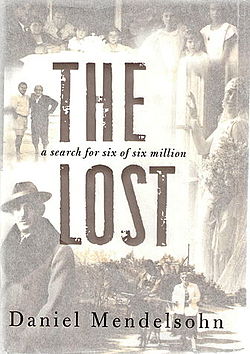
The Lost - A Search for Six of Six Million (Daniel Mendelsohn, 2006)

Wasn't really looking for *another* Holocaust book.  But PJ was recommending this pretty strongly, so I thought I'd be a good sport and take it up.

Very glad that I did - some perspectives that I found quite unique.


The author is a professional writer - NY Review of Books, NYT magazine, that sort of thing - and became deeply interested in history even as a child, he thinks due to influence of his grandfather.  Family origins in Bolechow, Poland; many emigrate as things get tough; six stay behind and disappear as Germany takes over following Hitler turning on Stalin in 1941.  Limited and not always consistent information is available about how the six were liquidated, but author decides to search for more.

Travels to Bolechow; then Australia, Israel, Scandinavia.  Reconnects (or connects) with photographer brother who seems to do very nice work (wish the photos had been given more prominence in the book).

Author uses a meandering storytelling style - takes some patience - 503 pages - but well worth it.  Interactions with survivors; some pretty amazing coincidences enable information to be discovered; very powerful as author descends into the kestl.

Particularly useful to me - he pulls together threads I'm pursuing - family history research; weaves Old Testament stories (particularly Cain & Abel, Noah, Abraham), along with interpretations from two Torah commentators, into his narrative; Jewish history in eastern Europe; stories of the Polish borderlands (Galicia), last flickering remnants of the old Habsburg days; plenty of tension among Poles, Ukrainians and Jews but at least they could live together and function for the most part (other than the occasional outbursts, which were awful enough).  Jews now all gone.

The awful episodes during the several Aktions, including at Dom Katolick. Hidden in a teacher's house.  Polish boy makes the mistake(?) of falling for a Jewish girl.  Uncle Shmiel loses his permit to run his truck.  Stuff that happened with Jews under 1930s German diktats (with plenty of local collaboration) - wow.  Ukrainians take advantage.

Searching for the personal detail that prevents - ok, only delays - a person (pretty much every person, ultimately) from being entirely, utterly forgotten.  Searching for how it might have felt (not just how it happened).

Author states that his grandfather was renowned for his storytelling ability, and he tries to describe his grandfather's method; then describes his dilemma about how to shape the story he is learning about in his researches . . . of course he's signalling that he will be using his grandfather's method to tell this tale.  Which he does, very effectively.